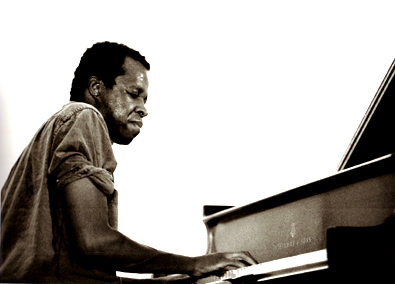
|
The
|
|
|
Reproduced with permission. |
- The Matthew Shipp Website, a treasure-trove of articles, interviews and photos.
- Contact Alan Schneider (Matthew Shipp Management / No More Records) for bookings, tour info, recordings, etc.
- Tour and concert info at AUM Fidelity.
- Henry Rollins' 2.13.61 Records / Infinite Zero Web-site for Shipp info.
- Perfect Sound Forever, June 1999 issue / Extensive Matthew Shipp Interview by Dave Reitzes.
- Info (including Shipp's "Boxing and Jazz"; an interview from NOW Magazine; a feature from the Boston Phoenix) at AUM Fidelity website.
- Matthew Shipp interview by Pete Gershon.
- Adam Shatz's feature article on Matthew Shipp: POP MUSIC; A Jazz Pianist Stands Tall in the Rock Underground, from the January 25, 1998 Sunday Arts and Leisure section of the New York Times.
- "Matthew Shipp meditates on the philosophical and spiritual natures of improvisation" -- excerpt from issue #1 of Chris Rice's Halana Magazine.
[This also includes a 45 rpm single from the September 1, 1995 session.]- The companion David S. Ware and William Parker Sessionographies, and the Susie Ibarra Discography.
- Current details search list. Info I require to complete this document. Please take a look.
- Matthew Shipp Interview by Pete Gershon, October 2, 1997.
- 2-Z liner notes by Robert Hicks.
- Third Ear Recitation liner notes by Ben Ratliff.
- Thanks to those who've helped.
Session-by-session listing:
- 87.11.19 / Matthew Shipp & Rob Brown: Sonic Explorations (Cadence Jazz)
+ 88.02.14 - 88.02.14 / Matthew Shipp & Rob Brown: Sonic Explorations (Cadence Jazz)
- 90.01.08 / David S. Ware: Great Bliss Volumes 1 & 2 (Silkheart)
+ 90.01.09; 90.01.10 - 90.01.09 / David S. Ware: Great Bliss Volumes 1 & 2 (Silkheart)
- 90.01.10 / David S. Ware: Great Bliss Volumes 1 & 2 (Silkheart)
- 90.01.14 / Matthew Shipp: Points (Silkheart)
+ 90.03.18 - 90.10.16 / Matthew Shipp Trio: Circular Temple
- Various Artists: The Infinite Zero Almanac 1996, Sampler Volume IV (Infinite Zero)
- Various Artists: Infinite Zero Sampler VI 1997 (Infinite Zero)
- Various Artists: Infinite Zero Promotional Sampler #3 (Infinite Zero)
- Various Artists: The Infinite Zero Almanac 1996, Volume V (Infinite Zero)
- 90.11.12 / Marc Edwards Quartet: Black Queen
- 91.12.10 / David S. Ware: Flight of I
- 91.12.11 / David S. Ware: Flight of I
- 92.05.18 / Roscoe Mitchell: This Dance is for Steve McCall
- Roscoe Mitchell (& the Note Factory): The Jazz Masters, 100 anos de Swing (Folio Collection)
- 92.06.01 / Matthew Shipp: Why We Came Together—A Yakuza Compilation
- 92.10.14 / David S. Ware: Third Ear Recitation
- 92.10.15 / David S. Ware: Third Ear Recitation
- 93.03.26 / Matthew Shipp: Prism
- 93.05.00 / Matthew Shipp Duo with William Parker: ZO
- Yakuza #6 Magazine & 7" EP
- Various Artists: 213CD 1996 Part One (213CD)
- 94.05.04 / David S. Ware: Earthquation
- 94.05.05 / David S. Ware: Earthquation
- 94.09.23 / Matthew Shipp Quartet: Critical Mass
- Various Artists: 213CD Sampler 1995 (213CD)
- 94.12.02 / David S. Ware Quartet: Cryptology
- 95.05.14 / Matthew Shipp: The Flow of X
- 95.06.14 / Matthew Shipp: Before the World
- 95.06.15 / Matthew Shipp: Before the World]
- 95.08.15 / Matthew Shipp Duo with Roscoe Mitchell: 2-Z
- Various Artists: 213CD 1996 Part One / 213CD
- 95.09.01 / Matthew Shipp: Halana #1 (Halana Magazine)
- 95.09.27 / David S. Ware Quartet: Oblations and Blessings
- 95.09.28 / David S. Ware Quartet: Oblations and Blessings
- 95.09.29 / David S. Ware: DAO
- 95.11.22 / Matthew Shipp: Symbol Systems
- 96.01.00 / Ivo Perelman & Matthew Shipp: Bendíto of Santa Cruz
- 96.01.00 / Ivo Perelman & Matthew Shipp: Brazilian Watercolor
- 96.02.26 / Joe Morris Ensemble: Elsewhere
- 96.05.02 / David S. Ware Quartet: Godspelized
- 96.05.03 / David S. Ware Quartet: Godspelized
- 96.06.06 / Ivo Perelman: Cama de Terra
- 96.06.19 / David S. Ware Quartet: Knitting Factory What Is Jazz? Festival 1996
- Various Artists: The Heineken Jazz Groove 1996
- 96.06.26 / Matthew Shipp: Knitting Factory What Is Jazz? Festival 1996
- Various Artists: The Heineken Jazz Groove 1996
- Various Artists: The Texaco New York Jazz Festival Radio Series Live at The Knitting Factory (Knitting Factory)
- 96.08.05 / Matthew Shipp String Trio: By the Law of Music
- 96.10.12 / Rob Brown Duo with Matthew Shipp: Blink of an Eye
- 96.12.02 / David S. Ware: Wisdom of Uncertainty
- 96.12.03 / David S. Ware: Wisdom of Uncertainty
- 97.01.23 / Matthew Shipp / Joe Morris: Thesis
- 97.05.00 / Roscoe Mitchell and the Note Factory: Nine To Get Ready
- Various Artists: ECM Selected Recordings, I-VIII
- Art Ensemble Of Chicago: Selected Recordings , Rarum VI
- 97.05.29 / Matthew Shipp & Rob Brown Duo: Vision One—Vision Festival 1997 Compiled
- 97.05.30 / David S. Ware Quartet: Vision One—Vision Festival 1997 Compiled
- 97.07.17 / Matthew Shipp: The Multiplication Table
- 97.12.02 / Other Dimensions in Music Special Quintet w/ Matthew Shipp: Time Is Of The Essence; The Essence Is Beyond Time
- 97.12.11 / David S. Ware: Go See the World
- Various Artists: Jazziz On Disc (Jazziz Magazine)
- 97.12.12 / David S. Ware: Go See the World
- 97.12.14 / Matthew Shipp Horn Quartet: Strata
- 98.05.10 / Matthew Shipp Duo with Mat Maneri: Gravitational Systems
- 98.08.14 / Mat Maneri Trio: So What
- 98.11.13 / Steve Dalachinsky: Incomplete Directions (Knitting Factory)
- 99.01.06 / Matthew Shipp Duo with William Parker: DNA
- Various Artists: Wish You Were Here / Love Songs for New York (Village Voice Records)
- 99.01.26 / Matthew Shipp, Rob Brown, William Parker: Magnetism
- 99.10.00 / Documentary: David S. Ware [Broadcast Videotape] New York City
- 99.10.20 / David S. Ware Quartet: Surrendered
- Documentary: David S. Ware [Broadcast Videotape] New York City
- 99.10.21 / David S. Ware Quartet: Surrendered
- Documentary: David S. Ware [Broadcast Videotape] New York City
- 99.11.05 / Documentary: David S. Ware [Broadcast Videotape] Strasbourg, France
- 99.11.06 / Documentary: David S. Ware [Broadcast Videotape] Bruxelles, Belgium
- 99.11.09 / David S. Ware Quartet, un concert Live [Broadcast Video] (Circeto Film Productions)
- 99.11.09 / Documentary: David S. Ware [Broadcast Videotape] Poitiers, Paris, France
- 99.11.18 / Matthew Shipp String Trio: Expansion, Power, Release (hat HUT)
- 00.01.06 / Matthew Shipp Quartet: Pastoral Composure (Thirsty Ear)
- 00.09.14 / Matthew Shipp: Matthew Shipp's New Orbit (Thirsty Ear)
- Various Artists: Blue Series Essentials (Thirsty Ear Recordings)
- 00.09.15 / The Nommonsemble: Life Cycle (AUM Fidelity)
- 01.00.00 (1) / Various Artists: State of the Union (Electronic Music Foundation)
- 01.00.00 (2) / QPSM Unit: The Seriousness of the Matter (Quadrophonic Sound Module)
- 01.01.14 / Spring Heel Jack: The Blue Series Continuum • Masses (Thirsty Ear)
- 01.02.26 / David S. Ware Quartet: Corridors & Parallels (AUM Fidelity)
- 01.02.27 / David S. Ware Quartet: Corridors & Parallels (AUM Fidelity)
- 01.04.05 / Andrew Barker, Matthew Shipp, Charles Waters: Apostolic Polyphony (Drimala Records)
- 01.08.09 (1) / Matthew Shipp: nu bop (Thirsty Ear Recordings)
- Various Artists: Blue Series Essentials (Thirsty Ear Recordings)
- 01.08.09 (2) / DJ Wally: Nothing Stays the Same (Thirsty Ear Recordings)
- 01.11.18 / Matthew Shipp: SONGS (Splasc(H) Records)
- 02.00.00 / Spring Heel Jack: The Blue Series Continuum • AMaSSED (Thirsty Ear Recordings)
- Various Artists: Blue Series Essentials (Thirsty Ear Recordings)
- 02.02.12 / Antipop Consortium: Antipop Consortium vs. Matthew Shipp (Thirsty Ear Recordings)
- Various Artists: Blue Series Essentials (Thirsty Ear Recordings)
- Various Artists: The Blue Series Sampler—The Shape of Jazz to Come (Thirsty Ear Recordings)
- 02.03.06 / DJ Spooky that Subliminal Kid: Optometry (Thirsty Ear Recordings)
- Various Artists: Blue Series Essentials (Thirsty Ear Recordings)
- DJ Wally: Nothing Stays the Same
- 02.06.12 / Maneri Ensemble: Going to Church (AUM Fidelity)
- 02.06.26 / Matthew Shipp: Equilibrium (Thirsty Ear Recordings)
- 02.07.13 / David S. Ware Quartet: Freedom Suite (AUM Fidelity)
- 02.10.01 / Antipop Consortium: Antipop Consortium vs. Matthew Shipp (Thirsty Ear Recordings)
- Various Artists: Blue Series Essentials (Thirsty Ear Recordings)
- Various Artists: The Blue Series Sampler—The Shape of Jazz to Come (Thirsty Ear Recordings)
- 02.11.01 / Antipop Consortium: Antipop Consortium vs. Matthew Shipp (Thirsty Ear Recordings)
- Various Artists: Blue Series Essentials (Thirsty Ear Recordings)
- Various Artists: The Blue Series Sampler—The Shape of Jazz to Come (Thirsty Ear Recordings)
- 03.01.09 / Matthew Shipp: The Sorcerer Sessions (Thirsty Ear Recordings)
- 03.04.28 / David S. Ware String Ensemble: Threads (Thirsty Ear Recordings)
- 03.07.12 / Matthew Shipp Trio: STOPSMILING 16 / Mag & 7"
- 04.00.00 (1) / El-P, featuring the The Blue Series Continuum: High Water
Thirsty Ear Recordings
- El-P, featuring the The Blue Series Continuum: Sunrise Over Brooklyn (Thirsty Ear Recordings)
- 03.07.12 / Matthew Shipp Trio: STOPSMILING 16 / Mag & 7"
- 2006.01.05 / Right Hemisphere: Right Hemisphere (RogueArt)
- 2007.00.00 / Matthew Shipp Trio: Piano Vortex (Thirsty Ear)
87.11.19 • Matthew Shipp & Rob Brown: Sonic Explorations
Cadence Jazz CJR 1037 (LP) 1988; CJR 1037 (CD) 20001st session [See also: 88.02.14]
November 19, 1987 / Evergreen Studio ("Possibly." —Rob Brown), New York City
- 1. Sonic Exploration Section 1 [8:04]
- 2. Sonic Exploration Section 2 [4:08]
- 3. Sonic Exploration Section 3 [6:25]
- 4. Sonic Exploration Section 4 [2:57]
- 5. Sonic Exploration Section 5 [5:13]
- 6. Sonic Exploration Section 6 [9:30]
Matthew Shipp (piano-1,2,3,4,6)
Rob Brown (alto sax-1,2,4,5,6)
(All compositions, collective)
{Primary Source: CJR 1037}
88.02.14 • Matthew Shipp & Rob Brown: Sonic Explorations
Cadence Jazz CJR 1037 (LP) 1988; CJR 1037 (CD) 20002nd session [See also: 87.11.19]
February 14, 1988 / Sorcerer Sound, New York City
- 7. Oleo (Sonny Rollins) [3:30]
- 8. Blue In Green (Bill Evans) [6:07]
- 9. Oleo (Sonny Rollins) take 2 [3:34]
- 10. Blue In Green (Bill Evans) take 2 [4:10]
Because of the mistaken track listing in the liners noted in the 1st session, CJR 1037 CD has the actual track 7 as 6, 8 as 7, 9 as 8, and 10 as 9. And here I thought all those doing the good work at CADENCE were infallible and god-like... —RL
Matthew Shipp (piano)
Rob Brown (alto sax)
{Primary Source: CJR 1037 LP & CD}
90.01.08
90.01.09
90.01.10 • David S. Ware Quartet: Great Bliss Vol. 1
Silkheart Records SHCD-127 (CD) 1991 SWD
David S. Ware Quartet: Great Bliss Vol. 2
Silkheart Records SHCD-128 (CD) 1991 SWDJanuary 8 through 10, 1990 / Sound on Sound Studio, New York City
- Volume 1:
- 1. Forward Motion [12:28]
- 2. Angular [5:50]
- 3. Bliss Theme [8:50]
- 4. Cadenza [11:40]
- 5. Sound Bound [12:00]
- 6. Mind Time [4:00]
- 7. Saxelloscape One [4:00]
- 8. Thirds [13:50]
- Volume 2:
- 1. One Two Three [12:00]
- 2. Emptiness [4:00]
- 3. Primary Piece III [8:30]
- 4. Saxelloscape Two [5:00]
- 5. The Child Without—The Child Within [10:50]
- 6. Stritchland [12:15]
- 7. Low Strata [6:20]
- 8. Reign of Peace [11:00]
Matthew Shipp (piano—all except 1/7 & 2/4)
William Parker (bass—all except 1/7 & 2/4)
Marc Edwards (drums, tympani; percussion—all except 1/7 & 2/4)
The CD liner notes indicate "does not appear on album" for several of these tracks.
"...Silkheart LP manufacture stopped in a big hurry and those two [SHCD-127 & 128] certainly weren't manufactured. The remarks on the backliner text are there because it wasn't possible to make any changes to the offset films at that late date..."
—Keith Knox, Silkheart Records]
{Primary Source: SHCD-128 & SHCD-127}
90.01.14 • Matthew Shipp Quartet: Points
Silkheart Records SHCD-129 (CD) 1990 SWD1st session [See also: 90.03.18]
January 14, 1990 / East Side Sound Studio, New York City
- 1. Points Number Two [20:42]
- 2. Afro Sonic [5:37]
- 3. Piano Pyramid [10:05]
Rob Brown (alto sax-1,2)
William Parker (bass, percussion-2)
Whit Dickey (drums, percussion-2)
{Primary Source: SHCD-129}
90.03.18 • Matthew Shipp Quartet: Points
Silkheart Records SHCD-129 (CD) 1990 SWD2nd session [See also: 90.01.14]
March 18, 1990 / East Side Sound Studio, New York City
- 1. Points Number One [34:24]
Rob Brown (alto sax)
William Parker (bass)
Whit Dickey (drums)
{Primary Source: SHCD-129}
90.10.16 • Matthew Shipp Trio: Circular Temple
Quinton Records QTN1 (CD) 1992; 2.13.61 Records / Infinite Zero Records Infinite Zero 9 14506-2 (CD) 1994- Various Artists: The Infinite Zero Almanac 1996, Sampler Volume IV
Infinite Zero Records Infinite Zero 9 00000-4 (CD) 1996
[This compilation also contains performances by Gang of Four; James White & the Blacks; Alan Vega; Devo; Alan Watts; Iceberg Slim; Flipper; Mississippi Fred McDowell; and Tom Verlaine.]
- Various Artists: The Infinite Zero Almanac 1996, Volume V
Infinite Zero Records Infinite Zero 9 000005 (CD) 1996
[This compilation also contains performances by Gang of Four; James White; Alan Vega; Devo; Alan Watts; Iceberg Slim; Flipper; Mississippi Fred McDowell; Louise Huebner; Trouble Funk; and Tom Verlaine.]
- Various Artists: Infinite Zero Sampler VI 1997
Infinite Zero Records [no catalogue #] (CD) 1997
[This compilation also contains performances by Devo; Monks; Trouble Funk; James Chance; Flipper; Gang of Four; Louise Huebner; Mississippi Fred McDowell; Iceberg Slim; Alan Vega; Tom Verlaine; and Alan Watts.]
- Various Artists: Infinite Zero Promotional Sampler #3 / Promo-CD 95.ZERO.3
Infinite Zero Records 9 00000-3 (CD) 1997
[This compilation also contains performances by Devo; Monks; Trouble Funk; James Chance; Flipper; Gang of Four; Louise Huebner; Mississippi Fred McDowell; Iceberg Slim; Alan Vega; Tom Verlaine; and Alan Watts.]
- 1. Circular Temple #1 [6:26]
- 2. Circular Temple #2 (Monk's Nightmare) [10:00]
- 3. Circular Temple #3 [3:47]
- 4. Circular Temple #4 [25:50]
The Infinite Zero Almanac 1996, Volume V has track 2 only.
Matthew Shipp (piano, Compositions)
William Parker (bass)
Whit Dickey (drums)
{Primary Source: QTN1; Infinite Zero 9 14506-2; 9 00000-4; 9 00000-3; 9 000005; Sampler VI 1997}
90.11.12 • Marc Edwards Quartet: Black Queen
Alphaphonics APCD1 (CD) 1991November 12, 1990 / East Side Sound Studio, New York City
- 1. Creation [10:45]
- 2. Bumblebees and Marigold Flowers [12:26]
- 3. Lite Free [10:29]
- 4. Black Queen [6:04]
- 5. Quadratic Equation
- Part I: Fate vs. Destiny [3:24]
- Part II: X = Unknown Quantity [4:21]
- Part III: Analytical Factoring [4:41]
- Part IV: Discriminant Resolution [0:29]
- A New Day—A New Age [9:22]
Matthew Shipp (piano)
Fred Hopkins (bass)
Laverne Maxwell (spoken words)
Marc Edwards (drums, percussion, Compositions)
{Primary Source: APCD1}
91.12.10
91.12.11 • David S. Ware: Flight of I
DIW DIW-856 (CD) JPN; DIW/Columbia CK52956 (CD) 1992December 10 & 11, 1991 / The Power Station, New York City
- 1. Aquarian Sound (Ware) [7:49]
- 2. There Will Never Be Another You (H. Warren/M. Gordon) [9:29]
- 3. Sad Eyes (A. Jones) [11:10]
- 4. Flight of I (Ware) [8:11]
- 5. Yesterdays (J. Kern/O. Harbach) [6:51]
- 6. Infi-Rhythms # 1 (Ware) [17:43]
Matthew Shipp (piano)
William Parker (bass)
Marc Edwards (drums)
{Primary Source: DIW-856}
92.05.18 • Roscoe Mitchell & the Note Factory: This Dance is for Steve McCall
Black Saint BS120150-2 (CD) 1992 IT- Roscoe Mitchell (& the Note Factory): The Jazz Masters, 100 anos de Swing
Folio Collection EF 20090 (CD) 1997 SP
- 1. Ericka (Joseph Jarman) [11:32]
- 2. Uptown Strut (Mitchell) [2:19]
- 3. The Rodney King Affair (Mitchell) [5:24]
- 4. Ah (Mitchell) [3:21]
- 5. Song For Gerald Oshita (Mitchell) [3:03]
- 6. Paintings For Phillip Wilson (Mitchell) [2:58]
- 7. The Far East Blues (Mitchell) [5:34]
- 8. Variations For String Bass And Piano (Mitchell) [6:56]
- 9. This Dance Is For Steve McCall (Mitchell) [9:56]
Matthew Shipp (piano)
Jaribu Shahid (bass)
William Parker (bass, percussion)
Tani Tabbal (drums, hand drum)
Vincent Davis (drums)
{Primary Source: BS120150-2; EF 20090}
92.06.01 • Various Artists: Why We Came Together / A Yakuza Compilation
Yakuza #8 Magazine & CD 1996June 1, 1992 / Live at WKCR, New York City
- 1. Sonic Host [4:55]
Matthew Shipp (piano, Composition)
Williamm Parker ? (bass)
Whit Dickey ? (drums)
{Primary Source: Yakuza #8}
92.10.14
92.10.15 • David S. Ware: Third Ear Recitation
DIW DIW-870 (CD) 1993 JPNOctober 14 & 15, 1992 / Sound on Sound Studio, New York City
- 1. Autumn Leaves (Joseph Kosma) [3:42]
- 2. East Broadway Rundown (Sonny Rollins) [9:39]
- 3. Mystic March (Ware) [5:38]
- 4. Angel Eyes (Matt Dennis) [7:17]
- 5. Third Ear Recitation (Ware) [4:41]
- 6. Free Flow Dialogue (Ware) [3:16]
- 7. Sentient Compassion (Ware) [6:45]
- 8. The Chase (Ware) [9:11]
- 9. Autumn Leaves (Joseph Kosma) [8:56]
Matthew Shipp (piano)
William Parker (bass)
Whit Dickey (drums)
Third Ear Recitation liner notes by Ben Ratliff.
{Primary Source: DIW-870}
93.05.00 • Matthew Shipp Duo with William Parker: ZO
Rise Records RR-126 (CD) 1994; 2.13.61 Records thi21315.2 (CD) 1997- Yakuza #6 {2}
Magazine & 7" EP - Various Artists: 213CD 1996 Part One {3}
213CD 213PRO2 (CD) Sampler 1995
- 1. ZO #1 (Shipp) [10:24]
- 2. Summertime (Gershwin) [12:01]
- 3. ZO #2 (Shipp) [13:28]
- 4. ZO #3 (Shipp) [14:02]
Yakuza #6 has track 2 only.
Matthew Shipp (piano)
William Parker (bass)
{Primary Source: thi21315.2; Yakuza #6; RR-126; 213PRO2; info from Craig...}
93.03.26 • Matthew Shipp Trio: Prism
Ectoplasm / Brinkman Records BRCD058/RÖV-009-2 (CD) 1995; hatOLOGY 549 (CD) 2000March 26, 1993
Roulette, New York City
- 1. Prism I [29:55]
- 2. Prism II [25:40]
William Parker (bass)
Whit Dickey (drums)
{Primary Source: BRCD058/RÖV-009-2; hatOLOGY 549}
94.05.04
94.05.05 • David S. Ware: Earthquation
DIW DIW-892 (CD) 1994 JPNMay 4 & 5, 1994 / Power Station, New York City
- 1. Canadian Sunset (Eddie Heywood and Norman Gimbel) [7:32]
- 2. Inverse Alchemy (Ware) [8:55]
- 3. Tenderly (Walter Gross andJack Lawrence) [5:35]
- 4. Ideational Blue (Ware) [8:26]
- 5. Cococana (Ware) [11:32]
- 6. Tenderly (Walter Gross and Jack Lawrence) [4:45]
- 7. Earthquation (Ware) [9:20]
Matthew Shipp (piano)
William Parker (bass)
Whit Dickey (drums)
{Primary Source: DIW-892}
94.09.23 • Matthew Shipp Quartet: Critical Mass
2.13.61 Records 213CD003 (CD) 1995; Thirsty Ear 3 (CD) 1996- Various Artists: 213CD Sampler 1995
213CD 213CDPRO1 (CD) Sampler 1995
[This compilation also contains performances by The Mark of Cain; Coyle & Sharp; TV Smith; Hubert Selby, Jr.; Alan Vega; Exene Cervenka; Suicide; Ian Sholes; Chris Haskett; Sky King; and The Birthday Party.]
- 1. Critical Mass [10:07]
- 2. Virgin Complex [9:10]
- 3. Density and Eucharist [21:43]
Matthew Shipp (piano, Compositions)
Mat Maneri (violin)
William Parker (bass)
Whit Dickey (drums)
{Primary Source: 213CD003; 213CDPRO1}
94.12.02 • David S. Ware Quartet: Cryptology
Homestead Records HMS220-2 (CD) 1995December 2, 1994 / Sound on Sound Studio, New York City
- 1. Cryptology:
- a) Solar Passage [6:42]
- b) Direction: Pleiades [9:04]
- c) Dinosauria [10:03]
- d) Cryptology / Theme Stream [14:19]
- e) Panoramic [10:45]
- f) The Liberator [10:44]
Matthew Shipp (piano)
William Parker (bass)
Whit Dickey (drums)
{Primary Source: HMS220-2}
95.05.14 • Matthew Shipp: The Flow of X
2.13.61 Records thi21326.2 (CD) 1997May 14, 1995 / Seltzer Sound Studio, New York City
- 1. flow of X [5:49]
- 2. flow of silence [6:12]
- 3. flow of Y [7:43]
- 4. flow of M [6:52]
- 5. flow of U [9:33]
- 6. instinctive codes [12:40]
Mat Maneri (violin)
William Parker (bass)
Whit Dickey (drums)
2 by Shipp / Limited Edition 45-rpm vinyl from the Gold Sparkle Band, covering the Shipp compositions Flow of X and Flow of Y.
{Primary Source: thi21326.2; master tape dates from Henry Rollins}
95.06.14
95.06.15 • Matthew Shipp: Before the World
FMP CD 81 (CD) 1997 GERJune 14 & 15, 1995 / Live at The Workshop Freie Musik '95, Akademie der Künste, Berlin, Germany
- 1. Before # 1 [32:44]
- 2. Before # 2 [5:42]
- 3. Before # 3 [3:42]
- 4. Before # 4 [4:09]
- 5. Before # 5 [22:07]
{Primary Source: FMP CD 81}
95.08.15 • Matthew Shipp Duo with Roscoe Mitchell: 2-Z
2.13.61 Records thi21312.2 (CD) 1996- Various Artists: 213CD 1996 Part One {2}
213CD 213PRO2 (CD) Promo 1995
- 1. 2-Z [3:10]
- 2. 2-Z-2 [4:03]
- 3. 2-Z-3 [4:46]
- 4. 2-Z-4 [3:47]
- 5. 2-Z-5 [2:53]
- 6. 2-Z-6 [2:46]
- 7. 2-Z-7 [2:40]
- 8. 2-Z-8 [4:13]
- 9. 2-Z-9 [2:54]
- 10. 2-Z-10 [6:02]
- 11. 2-Z-11 [6:46] (The Physics of Angels)
Matthew Shipp (piano)
Roscoe Mitchell (alto sax-1,2,3,5,7,11, soprano sax-4,6,9,10)
[Compositions collective]
2-Z liner notes by Robert Hicks.
{Primary Source: thi21312.2; 213PRO2; master tape dates from Henry Rollins}
95.09.01 • Various Artists: Halana #1
Halana #1 Magazine & 7" EP 1995September 1, 1995 / Ardmore, PA
- 1. Spinal Syntax 1 and 2 [3:33]
Both sides contain "Sculptures of Sonambient, Lock Grooves," performed by Val Bertoia.
Matthew Shipp (piano, Composition)
{Primary Source: Halana #1}
95.09.27
95.09.28 • David S. Ware Quartet: Oblations and Blessings
Silkheart Records SHCD-145 (CD) 1996 SWDSeptember 27 & 28, 1995 / Sound on Sound Studio, New York City
- 1. Oblations and Blessings [17:05]
- 2. Riff Unknown [10:53]
- 3. Of Shambala [11:05]
- 4. Fire Within [11:07]
- 5. Manu's Ideal [10:13]
- 6. Serpents and Visions [8:37]
Matthew Shipp (piano)
William Parker (bass)
Whit Dickey (drums)
{Primary Source: SHCD-145}
95.09.29 • David S. Ware: DAO
Homestead Records HMS230-2 (CD) 1996September 29, 1995 / Sound on Sound Studio, New York City
- 1. Interdao [6:22]
- Motif Dao [9:38]
- Rhythm Dao [7:00]
- Tao Above Sky [7:36]
- Dao Forms [18:16]
- Dao Feel [8:28]
- Dao [15:20]
Matthew Shipp (piano)
William Parker (bass)
Whit Dickey (drums)
{Primary Source: HMS230-2}
95.11.22 • Matthew Shipp: Symbol Systems
No More Records No. 1 (CD) 1995November 22, 1995 / Baby Monster Studios, New York City
- 1. Clocks [7:00]
- 2. Harmonic Oscillator [3:47]
- 3. Temperature Zone [1:52]
- 4. Symbol Systems [4:46]
- 5. The Highway [6:06]
- 6. Self-Regulated Motion [3:15]
- 7. Frame [5:11]
- 8. Flow of Meaning [7:11]
- 9. Dance of the Blue Atoms [3:23]
- 10. Bop Abyss [4:33]
- 11. Nerve Signals [3:29]
- 12. Algebraic Boogie [2:13]
- 13. The Inventor pt. 1 [4:13]
- 14. The Inventor pt. 2 [3:05]
{Primary Source: No More Records No. 1}
96.01.00-1 • Ivo Perelman & Matthew Shipp: Bendíto of Santa Cruz
Cadence Jazz CJR 1076 (CD) 1997January, 1996 / Systems Two Studio, Brooklyn, NY
- 1. Bendíto of Santa Cruz—take 1 (traditional) [1:42]
- 2. Macumba (traditional) [9:27]
- 3. Anglo (Perelman) [7:22]
- 4. Roses (traditional) [6:41]
- 5. Ze Do Vale (traditional) [5:39]
- 6. Cego (traditional) [4:43]
- 7. Cana Fita (traditional) [4:17]
- 8. Bandeirantes (Perelman) [6:02]
- 9. The Lion (Perelman) [3:08]
- 10. Bendíto of Santa Cruz—take 2 (traditional) [1:38]
Matthew Shipp (piano)
{Primary Source: CJR 1076}
96.01.00-2 • Ivo Perelman: Brazilian Watercolour
Leo Records CD LR 266 (CD) 1999 EnglandJanuary, 1996 / Systems Two Studio, Brooklyn, NY
- 1. Ascendent [5:27]
- 2. Traces [2:52]
- 3. Recitativo [2:20]
- 4. Explicativo [5:55]
- 5. Pal Piteira [6:36]
Ivo Perelman (tenor sax, Compositions)
Matthew Shipp (piano)
{Primary Source: CD LR 266}
96.02.26 • Joe Morris Ensemble: Elsewhere
Homestead HMS233-2 (CD) 1996February 26, 1996 / Sorcerer Sound Studio, New York City
- 1. Plexus [8:03]
- 2. Elsewhere [13:58]
- 3. Cirrus [5:13]
- 4. Violet [11:37]
- 5. Mind's Eye [6:16]
- 6. Rotunda [15:02]
Matthew Shipp (piano)
William Parker (bass)
Whit Dickey (drums)
{Primary Source: HMS233-2}
96.05.02
96.05.03 • David S. Ware Quartet: Godspelized
DIW DIW-916 (CD) 1997 JPNMay 2 & 3, 1996 / Sound on Sound, New York City
- 1. Godspelized (Ware) [15:44]
- 2. Wisdomsphere (Ware) [7:55]
- 3. Inner Temple (Ware) [6:40]
- 4. Wisdom Through Time (Ware) [7:54]
- 5. The Stargazers (Sun Ra) [12:26]
- 6. Eternal Forces of Brahm (Ware) [11:44]
- 7. Godspelized (Ware) [4:20]
Matthew Shipp (piano)
William Parker (bass)
Susie Ibarra (drums)
{Primary Source: DIW-916}
96.06.06 • Ivo Perelman: Cama de Terra
Homestead HMS237-2 (CD) 1996June 6, 1996 / Systems Two Studio, Brooklyn, NY
- 1. Soundcheck [0:48]
- 2. One Converse [2:58]
- 3. To Another [4:38]
- 4. Nho Quim [8:51]
- 5. Spiral [5:38]
- 6. Adriana [3:54]
- 7. Groundswell Descent [4:55]
- 8. Dedos [3:51]
- 9. Elephants Have Brains [2:40]
- 10. Cama de Terra [9:24]
- 11. The Dark of the Day [6:20]
Matthew Shipp (piano)
William Parker (bass)
{Primary Source: HMS237-2}
96.06.19 • Various Artists (David S. Ware Quartet): Knitting Factory What Is Jazz? Festival 1996
Knitting Factory Works KFW 195 (CD) 1996- Various Artists (David S. Ware Quartet): The Heineken Jazz Groove 1996
Knitting Factory Works KFW 195-P (CD) 1996 / Liner marking; CD marking is KFW 198-P —Promo only
June 19, 1996 / Knitting Factory, New York City
- 1. In This Love [8:14]
Matthew Shipp (piano)
William Parker (bass)
Susie Ibarra (drums)
{Primary Source: KFW 195}
96.06.26 • Various Artists (Matthew Shipp Solo): Knitting Factory What Is Jazz? Festival 1996
Knitting Factory Works KFW 195 (CD) 1996- Various Artists (Matthew Shipp Solo): The Heineken Jazz Groove 1996
Knitting Factory Works KFW 195-P (CD) 1996 / Liner marking; CD marking is KFW 198-P
Promo only - Various Artists (Matthew Shipp Solo): The Texaco New York Jazz Festival Radio Series Live at The Knitting Factory
Show 3: Exploring the Boundaries of Free and Composition {3}
A World of Energy [a radio sampler in paper sleeves w/ no select #] (6CD) 1998
[Disc 3 also features Cecil Taylor solo; William Parker's In Order to Survive; Reggie Workman Ensemble; Steve Lacy; Cecil Taylor Trio; Assif Tsahar and Susie Ibarra; Marilyn Crispell & Gerry Hemingway; Charles Gayle Trio; announcement segments by Steve Dalachinsky; and a ridiculous little "Jingle" that appears twice.]
These are all previously released tracks and excerpts done for a pre-festival radio promotion series.
June 26, 1996 / Knitting Factory, New York City
- 1. Instinct [5:54]
- 2. Instinct II [5:59]
The Texaco New York Jazz Festival Radio Series Live at The Knitting Factory has track 2 only.
The Texaco disc also includes a monologue by Shipp [1:30] on improvisation.
Matthew Shipp (piano, Compositions)
{Primary Source: KFW 195; KFW 198-P; Texaco CD #3}
96.08.05 • Matthew Shipp String Trio: By the Law of Music
hat HUT Records hat ART CD 6200 (CD) 1997 SWZ; hatOLOGY 574 (CD) 2002, SWZAugust 5, 1996 / Seltzer Sound, New York City
- 1. Signal (Shipp) [0:17]
- 2. By the Law of Music (Shipp) [2:51]
- 3. Implicit (Shipp) [6:58]
- 4. Fair Play (Shipp) [5:00]
- 5. Grid (Shipp) [6:45]
- 6. Whole Movement (Shipp) [3:05]
- 7. Game of Control (Shipp) [7:56]
- 8. Point to Point (Shipp) [4:21]
- 9. P X (Shipp) [3:28]
- 10. Grid (Shipp) [5:36]
- 11. Coo (Shipp) [5:05]
- 12. X Z U (Shipp) [4:81]
- 13. Solitude (Ellington) [4:53]
Mat Maneri (violin)
William Parker (bass)
{Primary Source: hat ART CD 6200}
96.10.12 • Rob Brown Duo with Matthew Shipp: Blink of an Eye
No More Records No. 3 (CD) 1997October 12, 1996 / Live at Roulette, New York City
- 1. Blink of an Eye Part 1 [28:44]
- 2. Blink of an Eye Part 2 [32:27]
- 3. Blink of an Eye Part 3 [8:44]
Matthew Shipp (piano)
(Compositions, collective)
{Primary Source: No More Records No. 3}
96.12.02
96.12.03 • David S. Ware: Wisdom of Uncertainty
AUM Fidelity AUM001 (CD) 1997December 2 & 3, 1996 / Sound on Sound, New York City
- 1. Acclimation [12:45]
- 2. Antidromic [7:47]
- 3. Utopic [15:34]
- 4. Alignment [7:16]
- 5. Sunbows Rainsets Blue [7:41]
- 6. Continuum [11:34]
Matthew Shipp (piano)
William Parker (bass)
Susie Ibarra (drums)
{Primary Source: AUM001}
97.01.23 • Matthew Shipp / Joe Morris: Thesis
hat HUT Records hatOLOGY 506 (CD) 1997 SWZJanuary 23, 1997 / Seltzer Sound, New York City
- 1. Thesis [4:08]
- 2. Fable [5:39]
- 3. Simple Relations [3:41]
- 4. Particle I [3:43]
- 5. The Wand [3:49]
- 6. Action and Reaction [5:22]
- 7. Center Of [5:33]
- 8. The Turnpike [5:35]
- 9. For Of "Y" [4:22]
- 10. Broader Orders [8:01]
- 11. Particle 2 [4:41]
- 12. The Middle Region [4:18]
- 13. Our Journey [4:35]
Joe Morris (guitar)
{Primary Source: hatOLOGY 506}
97.05.00 • Roscoe Mitchell and the Note Factory: Nine To Get Ready
ECM 1651 539 725-2 (CD) 1999 SWZ; 1651 78118-21651-2 (CD) 1999 US; Polydor KK ECM POCJ-1445 (CD) JAP- Various Artists: ECM Selected Recordings, I-VIII
ECM Records Rarum Series 017753 (10CD) 2002 SWZ - Art Ensemble Of Chicago: Selected Recordings , Rarum VI
ECM 440014196 9 2002 (24-Bit/96khz Format CD) 2002 SWZ
Avatar Studio, New York City
- 1. Leola [9:35]
- 2. Dream And Response [5:35]
- 3. For Lester B [6:07]
- 4. Jamaican Farewell [5:45]
- 5. Hop Hip Bip Bir Rip [5:59]
- 6. Nine To Get Ready [3:52]
- 7. Bessie Harris [6:47]
- 8. Fallen Heroes [6:33]
- 9. Move Toward The Light [3:24]
- 10. Big Red Peaches [2:03]
Roscoe Mitchell (soprano sax, alto sax, tenor sax, flute, voice, Compositions)
Hugh Ragin (trumpet)
George Lewis (trombone)
Matthew Shipp (piano)
Craig Taborn (piano)
Jaribu Shahid (bass, voice)
William Parker (bass)
Tanni Tabbal (drums, percussion, voice)
Gerald Cleaver (drums)
{Primary Source: ECM 1651 539 725-2}
97.05.29 • Various Artists (Matthew Shipp & Rob Brown Duo): Vision One—Vision Festival 1997 Compiled
AUM Fidelity AUM007/8 (2-CD, Ltd. Edition 1,000 copies) 19981st session [See also: 97.05.30]
May 29, 1997 / Angel Orensanz Center, New York City
- 1. Vision Statement 2 [9:25]
Rob Brown (flute)
Matthew Shipp (piano)
(Composition, collective)
{Primary Source: AUM007/8}
97.05.30 • Various Artists (David S. Ware Quartet): Vision One—Vision Festival 1997 Compiled
AUM Fidelity AUM007/8 (2-CD, Ltd. Edition 1,000 copies) 19981st session [See also: 97.05.29]
May 30, 1997 / Angel Orensanz Center, New York City
- 1. Lockup '97 [8:20]
Matthew Shipp (piano)
William Parker (bass)
Susie Ibarra (drums)
{Primary Source: AUM007/8}
97.07.17 • Matthew Shipp: The Multiplication Table
hat HUT Records hatOLOGY 516 (CD) 1998 SWZJuly 17, 1997 / Seltzer Sound, New York City
- 1. Autumn Leaves (Joseph Kosma) [8:10]
- 2. The New Fact (Shipp) [4:43]
- 3. The "C" Jam Blues (Duke Ellington) [13:09]
- 4. ZT 1 (Shipp) [5:25]
- 5. Take the "A" Train (Billy Strayhorn) [6:56]
- 6. ZT 2 (Shipp) [4:26]
- 7. The Multiplication Table (Shipp) [13:07]
- 8. ZT 3 (Shipp) [4:51]
William Parker (bass)
Susie Ibarra (drums)
{Primary Source: hatOLOGY 516}
97.12.02 • Other Dimensions in Music Special Quintet w/ Matthew Shipp:
Time Is Of The Essence; The Essence Is Beyond Time
AUM Fidelity AUM013 (CD) 2000December 2, 1997 / Knitting Factory, New York City
- 1. > [9:27]
- 2. > [4:25]
- 3. > [7:29]
- 4. > [3:44]
- 5. > [5:17]
- 6. > [23:32]
- 7. > [13:33]
Daniel Carter (alto sax, tenor sax, flute, trumpet)
Roy Campbell Jr. (trumpet, flugelhorn, pocket trumpet)
Matthew Shipp (piano)
William Parker (bass)
Rashid Bakr (drums)
{Primary Source: AUM 013}
97.12.11
97.12.12 • David S. Ware: Go See the World
Sony / Columbia Records CK 69138 (CD) 1998
- Various Artists: Jazziz On Disc Jazziz Magazine, JZD1098 October 1998 (Magazine & CD) 1998
- 1. Mikuro's Blues (Ware) [6:04]
- 2. Lexicon (Ware) [10:22]
- 3. Logistic (Ware) [9:51]
- 4. The Way We Were (Marvin Hamlisch, Alan & Marilyn Bergman) [14:34]
- 5. Quadrahex (Ware) [4:42]
- 6. Estheticmetric (Ware) [11:30]
- 7. Rapturelodic (Ware) [10:38]
David S. Ware (tenor sax)
Matthew Shipp (piano)
William Parker (bass)
Susie Ibarra (drums)
{Primary Source: CK 69138; JZD1098}
97.12.14 • Matthew Shipp Horn Quartet: Strata
hat HUT Records hatOLOGY 522 (CD) 1998December 14, 1997 / Sorcerer Sound, New York City
- Strata 1 [0:47]
- Strata 2 [1:23]
- Strata 3 [7:45]
- Strata 4 [3:18]
- Strata 5 [7:05]
- Strata 6 [3:33]
- Strata 7 [5:36]
- Strata 8 [5:30]
- Strata 9 [5:43]
- Strata 10 [5:20]
- Strata 11 [4:18]
- Strata 12 [6:41]
- Strata 13 [0:59]
- Strata 14 [0:50]
Roy Campbell (trumpet-3,5,7,9,10,12, pocket trumpet-1,14)
Daniel Carter (alto sax-3,6,12, tenor sax-5,6,7, flute-8, trumpet-1,3,10,14)
William Parker (bass-2,3,5,7,8,10,12,13)
The Strata Visualized:
| track | 1 | 2 | 3 | 4 | 5 | 6 | 7 | 8 | 9 | 10 | 11 | 12 | 13 | 14 |
| Campbell | X | X | X | X | X | X | X | X | ||||||
| Carter | X | X | X | X | X | X | X | X | X | |||||
| Parker | X | X | X | X | X | X | X | X | ||||||
| Shipp | X | X | X | X | X | X | X | X |
{Primary Source: hatOLOGY 522}
98.05.10 • Matthew Shipp Duo with Mat Maneri: Gravitational Systems
hat HUT Records hatOLOGY 530 (CD) 1999May 10, 1998 / Sorcerer Sound, New York City
- 1. Elasticity (Shipp) [4:48]
- 2. Greensleeves (traditional, arrangement Shipp) [4:43]
- 3. Series of Planes (Shipp) [5:31]
- 4. Knots (Shipp) [4:41]
- 5. Notes (Shipp) [5:11]
- 6. Two Elements (Shipp) [5:33]
- 7. Landscape Harmony (Shipp) [8:33]
- 8. Forcefield (Shipp) [8:19]
- 9. Gravitational Systems (Shipp) [8:15]
- 10. Naima (John Coltrane) [3:16]
Matthew Shipp (piano)
{Primary Source: hatOLOGY 530}
98.08.14 • Mat Maneri Trio: So What?
hat HUT Records hatOLOGY 529 (CD) 1999August 14, 1998 / Sorcerer Sound, New York City
- 1. Asunta (Maneri) [8:02]
- 2. So What? (Miles Davis) [3:36]
- 3. Sunned (Maneri) [6:34]
- 4. Circle (Miles Davis) [7:56]
- 5. Three Smiles (Maneri) [7:18]
- 6. Cathedral (Maneri) [7:29]
- 7. Solar (Miles Davis) [3:35]
- 8. Solaris (Maneri) [10:27]
- 9. No Blues (Miles Davis) [8:47]
Matthew Shipp (piano)
Randy Peterson (drums)
{Primary Source: hatOLOGY 529}
98.11.13 • Steve Dalachinsky: Incomplete Directions
Knitting Factory Records KFR-235 (CD) 1999[This disc also includes pieces w/ accompaniment by: Daniel Carter & Sabir Mateen; Vernon Reid; William Parker; Stephanie Stone; Thurston Moore & Tom Surgal; Mat Maneri; Susie Ibarra & Assif Tsahar; Vito Ricci; and Roy Campbell.]
November 13, 1998 / Knitting Factory, New York City
- 1. 3 card monty (or eating the red) [1:11]
- 2. one thin line [1:53]
- 3. the conquest [3:05]
- 4. slim slow swimmer [2:34]
Matthew Shipp (piano)
Rob Brown (flute-3)
(All compositions, collective)
{Primary Source: KFR-235; session date from Steve Dalachinsky}
98.12.11 • David S. Ware Quartets: Live in the World
Thirsty Ear THI 57153.2 (3CD) 20051st Session: [See also 03.03.27 & 03.06.22]
- David S. Ware Quartet [Broadcast Recording]
Produced by RSI Radio Svizzera Internationale (Lugano) / Broadcast 98.12.28
European Digital Radio (ADR - Astra Digital Radio)
- THI 57153.2:
- 1. Aquarian Sound (Ware) [31:89]
- 2. Logistic (Ware) [18:42]
- 3. The Way We Were (Hamlisch) [17:43]
- 4. Mikuro's Blues (Ware) [9:05]
- 5. Lexicon (Ware) [3:59]
- 6. The Stargazer (Ware) [14:36]
- Broadcast Recording:
- 1. Lexicon (Ware) [3:36]
- 2. Aquarian Sound (Ware) [31:25]
- 3. The Stargazers (Sun Ra) [14:34]
- 4. Mikuro's Blues (Ware) [2:53] (incomplete, includes band intro)
David S. Ware (tenor sax / Arrangement)
Matthew Shipp (piano)
William Parker (bass)
Susie Ibarra (drums)
{Primary Source: THI 57153.2; Anne Dumas; Siegfried Otto; Holger Neuhaus}
99.01.06 • Matthew Shipp Duo with William Parker: DNA
Thirsty Ear Recordings thi 57067.2 (CD) 1999- Various Artists: Alternative Distribution Alliance May '99 Sampler
Alternative Distribution Alliance ADA 20036 (Promo only CD) 1999
[This disc also includes pieces by: Zakk Wylde's Black Label Society; Chevelle; Lorenzo Arruga, Dave Lombardo & Friends; Enuff Znuff; Whistler; The Smoke; and The Black Halos.] - Various Artists: Wish You Were Here—Love Songs for New York
Village Voice Records VVR 001 (CD) 2002
[This disc also includes pieces by: Moby; Cornershop; Mekons; Joseph Arthur; Moe Tucker; Andrew W.K.; Hydraulic Funk w/ Afrikaa Bambaataa; Ari Upp; Sheila Chandra; Hakim; Gogol Bordello; Uri Caine; Loudon Wainwright III; The Du-Tels; Atmosphere; Baaba Maal; and Lenny Dee.]
- 1. When Johnny Comes Marching Home (traditional) [4:04]
- 2. Cell Sequence (Shipp) [7:03]
- 3. Genetic Alphabet (Shipp) [12:45]
- 4. DNA (Shipp) [5:26]
- 5. Orbit (Shipp) [4:31]
- 6. Mr. Chromosome (Shipp) [11:42]
- 7. Amazing Grace (traditional) [2:02]
VVR 001 has track 7.
Matthew Shipp (piano)
William Parker (bass)
{Primary Source: thi 57067.2; VVR 001; ADA 20036}
99.01.26 • Matthew Shipp, Rob Brown, William Parker: Magnetism
Bleu Regard CT 1957 (CD) 1999 FRJanuary 26, 1999 / Seltzer Sound, New York City
- 1. Magnetism I [0:55]
- 2. Magnetism II [3:19]
- 3. Magnetism III [3:48]
- 4. Magnetism IV [2:28]
- 5. Magnetism V [3:29]
- 6. Magnetism VI [1:10]
- 7. Magnetism VII [3:07]
- 8. Magnetism VIII [4:11]
- 9. Magnetism IX [0:28]
- 10. Magnetism X [3:24]
- 11. Magnetism XI [3:38]
- 12. Magnetism XII [0:43]
- 13. Magnetism XIII [4:08]
- 14. Magnetism XIV [2:18]
- 15. Magnetism XV [4:54]
- 16. Magnetism XVI [0:53]
- 17. Magnetism XVII [3:05]
- 18. Magnetism XVIII [3:42]
- 19. Magnetism XIX [1:41]
- 20. Magnetism XX [5:32]
| Player | 1 | 2 | 3 |
4 | 5 | 6 | 7 | 8 | 9 | 10 |
11 | 12 | 13 | 14 | 15 | 16 | 17 | 18 | 19 | 20 |
| Matthew Shipp (piano / Compositions) | p | p | — | p | p | — | p | p | — | p |
p | p | p | p | p | — | p | p | — | p |
| Rob Brown (alto sax, flute) | as | as | fl | — | as | fl | fl | as | — | as |
as | — | as | as | as | fl | as | fl | fl | as |
| William Parker (bass) | b | b | b | — | b | — | b | b | b | b |
b | — | b | b | b | — | b | b | — | b |
{Primary Source: CT 1957}
99.03.31 • David S. Ware Quartet: Balladware
Thirsty Ear Blue Series 57132 (CD) 2006- Various Artists: The Blue Series Sampler—The 30th Year
Thirsty Ear Records (no issue # ? ) The Blue Series (CD) 2006
[This compilation also contains tracks from William Parker Violin Trio 02.05.00; Beans; Scotty Hard 06.00.00; Sex Mob; Nils Peter Molvaer; Meat Beat Manifesto; Carl Hancock Rux; Eri Yamamoto; Craig Taborn; DJ Spooky and Dave Lombardo; Groundtruther; Mike Ladd; The Yohimbe Brothers; and 30 Spokes] - David S. Ware Quartet [Broadcast Recording]
Broadcast 99.09.18; repeat broadcast 00.09.09; repeat abridged 06.02.03, 23:30-1:00 / "Jazz on 3," BBC Radio 3, London, England
"...they scheduled a recording session the day after they came back to the States. But the fickle finger of fate wagged at them, for they were all exhausted, effectively wiping out a high energy performance. So after a few futile attempts to record, the DSW Quartet came to a realization that the only way to match their energy level was in a ballad mode, which caught everyone by surprise."
- 1. Sentient Compassion (Ware) [8:25]
- 2. Tenderly (Walter Gross/Jack Lawrence) [9:14]
- 3. Angel Eyes (Matt Dennis) [15:30]
- 4. Yesterdays (Jerome Kern/O. Harbach) [12:23]
- 5. Dao Feel (Ware) [10:52]
- 6. Autumn Leaves (Joseph Kosma) [7:54]
- 7. Godspelized (Ware) [8:30]
- [72:44]
Broadcast Recording opens with a BBC Introduction, and has a David S. Ware Interview by Jez Nelson [7:34] between tracks 3 and 4.
Broadcast dated 06.02.03 has tracks 1, 6, 4, and 7 in that order.
David S. Ware (tenor sax)
Matthew Shipp (piano)
William Parker (bass)
Guillermo E. Brown (drums)
{Primary Source: CD-R; session venue and date from Anne Dumas, with a little help on the correct session date from Giovanni Corda and Giorgio Mortarino 07.01.06; WIRE #197 July 2000 p.81; www.bbc.co.uk/radio3/jazzon3/pip/93tzz/; web sources}
99.10.00 • Documentary: David S. Ware, un Film de Arthur Cemin et Romain Wentzo [Broadcast Video Recording]
Television Broadcast, Circeto Film Productions, in coproduction with MCM Classique Jazz-MUZZIK (2000)1st Session: [See 99.10.20-21; 99.11.05; 99.11.06; 99.11.09.]
Early October, 1999 / Rehearsal sessions, New York City
- Rehearsals, interviews, footage of New York City [24:00] (beginning of film)
David S. Ware (tenor sax)
Matthew Shipp (piano)
William Parker (bass)
Guillermo E. Brown (drums)
{Primary Source: Video; Circeto website}
99.10.20
99.10.21 • David S. Ware: Surrendered
Sony / Columbia Records CK 63816 (CD) 2000
- Documentary: David S. Ware, un Film de Arthur Cemin et Romain Wentzo
Television Broadcast, Circeto Film Productions, in coproduction with MCM Classique Jazz-MUZZIK (2000)
2nd Session: [See 99.10.00; 99.11.05; 99.11.06; 99.11.09.]
["...studio recording time from the Surrendered sessions..."]
- 1. Peace Celestial (Ware) [8:28]
- 2. Sweet Georgia Bright (Charles Lloyd) [5:15]
- 3. Theme of Ages (Ware) [7:44]
- 4. Surrendered (Ware) [7:58]
- 5. Glorified Calypso (Ware) [6:02]
- 6. African Drums (Beaver Harris) [16:53]
Matthew Shipp (piano)
William Parker (bass)
Guillermo E. Brown (drums)
{Primary Source: CK 63816; Video; Circeto website}
99.11.05 • Documentary: David S. Ware, un Film de Arthur Cemin et Romain Wentzo
Television Broadcast, Circeto Film Productions, in coproduction with MCM Classique Jazz-MUZZIK (2000)3rd Session: [See 99.10.00; 99.10.20-21; 99.11.06; 99.11.09.]
November 5, 1999 / Jazz d'Or Festival at Centre Culturel Strasbourg-Neudorf, Strasbourg, France
This documentary contains interviews... rehearsals, footage of New York City... studio recording time from the Surrendered sessions, and tour and concert footage from London, Strasbourg, Bruxelles, and Poitiers.
David S. Ware (tenor sax)
Matthew Shipp (piano)
William Parker (bass)
Guillermo E. Brown (drums)
{Primary Source: Video; Anne Dumas 03.07.10; Circeto website}
99.11.06 • Documentary: David S. Ware, un Film de Arthur Cemin et Romain Wentzo
Television Broadcast, Circeto Film Productions, in coproduction with MCM Classique Jazz-MUZZIK (2000)4th Session: [See 99.10.00; 99.10.20-21; 99.11.05; 99.11.09.]
November 6, 1999 / Societe Philharmonique de Bruxelles, Halles de Schaerbeek, Bruxelles, Belgium
This documentary contains interviews... rehearsals, footage of New York City... studio recording time from the Surrendered sessions, and tour and concert footage from London, Strasbourg, Bruxelles, and Poitiers.
David S. Ware (tenor sax)
Matthew Shipp (piano)
William Parker (bass)
Guillermo E. Brown (drums)
{Primary Source: Video; Anne Dumas 03.07.10; Circeto website}
99.11.09 • Muzzik Presents Jazz: David S. Ware Quartet In Concert [Broadcast Video & Radio Broadcast Recording]
Television Broadcast, Circeto Film Productions, in coproduction with MCM Classique Jazz-MUZZIK (2000)- Documentary: David S. Ware, un Film de Arthur Cemin et Romain Wentzo
Television Broadcast, Circeto Film Productions, in coproduction with MCM Classique Jazz-MUZZIK (2000)
[This documentary contains interviews... rehearsals, footage of New York City... studio recording time from the Surrendered sessions, and tour and concert footage from London, Strasbourg, Bruxelles, and Poitiers.]
5th Session: [See 99.10.00; 99.10.20-21; 99.11.05; 99.11.06.]
- Broadcast Video:
- 1. Aquarian Sound (Ware) [26:06]
- 2. Angel Eyes (Matt Dennis) [16:33]
- announcement by D.S. Ware [0:35]
- 3. Mikuro's Blues (Ware) [8:24]
- 4. encore: Manu's Ideal (Ware) [7:12]
- [58:52]
David S. Ware (tenor sax)
Matthew Shipp (piano)
William Parker (bass)
Guillermo E. Brown (drums)
{Primary Source: CD-R; Video; Circeto website; Anne Dumas 03.07.10}
99.11.18 • Matthew Shipp String Trio: Expansion, Power, Release
hat HUT Records hatOLOGY 558 (CD) 2001 SWZNovember 18, 1999 / Seltzer Sound, New York City
- 1. Organs [2:22]
- 2. Expansion [2:57]
- 3. Waltz [3:58]
- 4. Combinational Entity [2:31]
- 5. Speech of Form [5:01]
- 6. Environment [3:00]
- 7. Weave Now a Web Rooted [5:38]
- 8. Connection [2:27]
- 9. Pulse Form [3:10]
- 10. Power [8:23]
- 11. Functional Form [2:58]
- 12. Reflex [2:21]
- 13. Release [8:07]
- 14. One More [3:11]
Mat Maneri (violin)
William Parker (bass)
{Primary Source: hatOLOGY 558}
00.01.06 • Matthew Shipp Quartet: Pastoral Composure
Thirsty Ear Recordings (The Blue Series) THI 57084-2 (CD) 2000January 6, 2000 / Seltzer Sound, New York City
- 1. Gesture (Shipp) [6:49]
- 2. Visions (Shipp) [7:56]
- 3. Prelude to a Kiss (Duke Ellington) [4:38]
- 4. Pastoral Composure (Shipp) [4:39]
- 5. Progression (Shipp) [5:33]
- 6. Frère Jacques (traditional) [5:36]
- 7. Merge (Shipp) [5:46]
- 8. Inner Order (Shipp) [3:44]
- 9. XTU (Shipp) [3:34]
Roy Campbell (trumpet, pocket trumpet, flugelhorn)
William Parker (bass)
Gerald Cleaver (drums)
{Primary Source: THI 57084-2}
00.09.14 • Matthew Shipp: Matthew Shipp's New Orbit
Thirsty Ear Recordings (The Blue Series) THI 57095-2 (CD)- Various Artists: Blue Series Essentials
Thirsty Ear Recordings (Borders Bookstores Promo Sampler) THI 57124.2 (CD) 2002
[This compilation also contains performances by William Parker Trio; Matthew Shipp's nu bop 01.08.09 (1); William Parker Quartet ; Antipop Consortium 02.02.12 or 02.10.01 or 02.11.01 (Thirsty Ear is unclear and provides no split session info); DJ Spooky 02.03.06; Mat Maneri; Guillermo E. Brown; Craig Taborn; Tim Berne; Roy Campbell; and Spring Heel Jack.]
- 1. New Orbit [2:59]
- 2. Paradox X [4:31]
- 3. Orbit 2 [3:39]
- 4. Chi [7:50]
- 5. Orbit 3 [2:23]
- 6. U Feature [3:56]
- 7. Syntax [7:16]
- 8. Maze Hint [1:09]
- 9. Paradox Y [3:54]
- 10. Orbit 4 [1:31]
Matthew Shipp (piano / Compositions)
Wadada Leo Smith (trumpet)
William Parker (bass)
Gerald Cleaver (drums)
{Primary Source: THI 57095-2}
00.09.15 • The Nommonsemble: Life Cycle
AUM Fidelity AUM020 (CD) 2001September 15, 2000 / Hillside Sound, Englewood, NJ
- 1. Wonder [5:32]
- 2. War [7:03]
- 3. Games [4:49]
- 4. Love [7:02]
- 5. Acceptance [7:55]
- 6. Transformation [9:20]
Rob Brown (alto sax, flute)
Mat Maneri (viola)
Whit Dickey (drums, Compositions)
{Primary Source: AUM020}
01.00.00 (1) • Various Artists (Matthew Shipp Solo): State of the Union
Electronic Music Foundation EMF CD 028 (3CD) 2001unknown date / ZOAR studio, New York City
- 1. Notes Cry Out [1:01]
—correspondence from Alan Schneider
Matthew Shipp (processed piano, Composition)
{Primary Source: EMF CD 028; session venue from Mr. Shipp via Alan Schneider}
01.00.00 (2) QPSM Unit: The Seriousness of the Matter
Quadrophonic Sound Module QPS 1101 (LP) 2001Date ?, 2001
Planet to Planet, and Sorcerer Sound, New York City
- 1. Brooklyn Inferno (Masey and Ben Judah) [ : ]
- 2. Ode to the Supa Dupa Moms (Henry) [ : ]
- 3. Long Arithmatic (sic) (Shipp) [ : ]
- 4. Alayaza (Ben Judah) [ : ]
- 5. R.A.S. The Hustler of the Movement (N'Diaye and Ben Judah) [ : ]
Sabir Mateen (tenor sax-3)
Zane Massey (tenor sax-1,4)
Frank "Ku-Umba" Lacy (trombone and fluegelhorn-1,4)
Masuja (guitar)
Tulivu Cumberbatch (vocals-2,5)
RaDu Olahu Ben Judah (acoustic and electric bass)
Ras Tschaka Tonge (congas; chekere)
Amos Oscar Debe (percussion-5)
Sawadogo Levi (percussion-5)
Rachid Rivers (percussion-1,4)
Joy Chatel (percussion-1,4)
Lee "Beaver" Pearson (d-5) [listed as "Lee 'Beaver' Harris" with a paste-over above. One of many typos in the liners.]
{Primary Source: QPS 1101}
01.01.14 • Spring Heel Jack: The Blue Series Continuum ° Masses
Thirsty Ear Recordings (The Blue Series) THI 570103.2 (CD) 2001- Various Artists (Spring Heel Jack & The Blue Series Continuum): The WIRE 20 1982-2002: Audio Issue
Mute Records Ltd. CD STUMM 220 (3CD Compilation Box Set) UK 2002
[This compilation includes tracks by Steve Lacy; Ennio Morricone (with Gruppo Di Improvvisazione Nuova Consonanza); Coil; Vivian Jackson & King Tubby; Derek Bailey; Cabaret Voltaire; Tony Conrad with Faust; Fela Kuti; The Art Ensemble Of Chicago; Sonic Youth; This Heat; Sun Ra & His Solar-Myth Arkestra; Christian Marclay; John Cage; Björk; Terry Riley; Suicide; John Fahey; Diamanda Galas, and others...]
- 1. Chorale [9:13]
- 2. Masses [5:33]
- 3. Salt [4:45]
- 4. Interlude 2 [3:05]
Spring Heel Jack:
John Coxon ("all other Instruments")
Ashley Wales ("all other Instruments")
(Compositions, Spring Heel Jack)
With:
Evan Parker (soprano sax-1,2,3)
Tim Berne (alto sax and baritone sax-2)
Daniel Carter (flute, alto sax, and tenor sax-2,4)
Roy Campbell (trumpet-2)
Matthew Shipp (piano-1,2,3)
Mat Maneri (viola-2)
William Parker (bass)
Guillermo E. Brown (drums-2,3,4)
{Primary Source: THI 570103.2; session date from FLAM 03.11.06; www.discogs.com}
01.02.26
01.02.27 • David S. Ware Quartet: Corridors & Parallels
AUM Fidelity AUM019 (CD) 2001February 26 & 27, 2001 / Sorcerer Sound, New York City
- 1. untitled (Ware) [1:20]
- 2. Straight Track (Ware) [10:02]
- 3. Jazz Fi-Sci (Ware) [4:22]
- 4. Superimposed (Ware) [5:58]
- 5. Sound-a-Bye (Ware) [3:08]
- 6. untitled (Ware) [0:37]
- 7. Corridors & Parallels (Ware / Shipp) [8:59]
- 8. Somewhere (Ware) [3:11]
- 9. Spaces Embraces (Ware) [3:17]
- 10. Mother May You Rest in Bliss (Ware) [6:07]
- 11. untitled (Ware) [1:48]
Clifton's question: 1) With Ware on "Corridors And Parallels" (excellent CD) how much of the programming by you and Guillermo was done in real time as the musicians played? How much, before or after the session? (and further to Matthew's reply:) On Corriders and Parallels most of the settings where chosen by Ware- its his synthesizer- he went out and bought it before the session.
Steven Joerg (producer): "...ALL of the music was recorded live in the studio; as you hear it on the album. Which makes it, I think, all the more remarkable. A lot of William Parker's gorgeous arco bass work on this album—wow; yeah. All of the synthesizer settings were chosen by David prior to the session, though there were some breaks where Matt was fiddling with different settings, and he might well have played something in like, 'bank E:16'..., that David dug and we went with it for a piece. The chimes, shells, and gong you hear are real instruments, and were all sounded by Guillermo.
'Jazz Fi-Sci' is an Acoustic Jazz Trio vs. Synth piece (think about the final scene in 'Close Encounters of the Third Kind'; Francois Truffaut's character playing the synthesizer being the equivalent of the Acoustic Jazz Trio, and the Alien's music being the Synth—yeah). 'Sumperimposed' is a 'trio' with synthesizer-generated rythym track, and Matt playing the additional percussion and whistles from the synthesizer keys..."
David S. Ware (tenor sax)
Matthew Shipp (synthesizer)
William Parker (bass)
Guillermo E. Brown (drums)
{Primary Source: AUM019} Corridors & Parallels at AUMFidelity.
01.04.05 • Andrew Barker, Matthew Shipp, Charles Waters: Apostolic Polyphony
Drimala Records DR 03-347-01 (CD) 2003April 5, 2001 / Sparkle Projects Series, Tonic, New York City
- 1. part-one invention [11:34]
- 2. two-part invention [3:56]
- 3. three-one invention [4:56]
- 4. part-two invention [3:50]
- 5. three-part invention [7:40]
- 6. three-two invention [9:05]
- 7. one-three invention [9:22]
- 8. part-four invention [10:32] Shannon Fields—remix
Charles Waters (B-flat clarinet, alto saxophone)
Andrew Barker (drums)
(All Compositions collective)
{Primary Source: Tom Hull correspondence 03.09.30} Not in my collection.
01.08.09 (1) • Matthew Shipp: nu bop
Thirsty Ear Recordings (The Blue Series) THI 57114-2 (CD) 2002- Various Artists: Blue Series Essentials {*}
Thirsty Ear Recordings (Borders Bookstores Promo Sampler) THI 57124.2 (CD) 2002
[This compilation also contains performances by William Parker Trio; Matthew Shipp's New Orbit 00.09.14; William Parker Quartet ; Antipop Consortium 02.02.12 or 02.10.01 or 02.11.01 (Thirsty Ear is unclear and provides no split session info); DJ Spooky 02.03.06; Mat Maneri; Guillermo E. Brown; Craig Taborn; Tim Berne; Roy Campbell; and Spring Heel Jack.]
- 1. Space Shipp [3:21] {*}
- 2. Nu-Bop [6:07]
- 3. ZX-1 [4:16]
- 4. D's Choice [4:50]
- 5. X-Ray [3:27]
- 6. Rocket Shipp [7:35]
- 7. Select Mode 1 [1:23]
- 8. Nu Abstract [3:47]
- 9. Select Mode 2 [5:09]
Daniel Carter (saxophone and flute)
William Parker (bass)
FLAM (synthesizers and programming)
Guillermo E. Brown (drums)
{Primary Source: THI 57114-2; THI 57124.2; THI 57140.2; THI 57138.2; session date from FLAM 03.11.06}
01.08.09 (2) • DJ Wally: Nothing Stays the Same
Thirsty Ear Recordings (The Blue Series) THI 57140.2 (CD) 2003- Various Artists: The Blue Series Sampler / The Shape of Jazz to Come {*}
Thirsty Ear Recordings THI 57138.2 (CD) 2003
[This compilation also contains performances by Antipop Consortium 02.02.12 or 02.10.01 or 02.11.01 (Thirsty Ear is unclear and provides no split session info); DJ Spooky 02.03.06; William Parker Violin Trio ; Kidd Jordan & Fred Anderson Quartet; Matthew Shipp 02.06.26; Blue Series Continuum 03.00.00 (1); Blue Series Continuum 03.01.09; David S. Ware String Ensemble 03.04.28; El-P 04.00.00 (1); Tim Berne; and Spring Heel Jack.]
August 9, 2001 / Sorcerer Sound, New York City
- 1. Thirsty Thrills [4:38]
- 2. Out of the Blue [4:41] {*}
- 3. Paint by Number [5:08]
- 4. Medley [4:20]
David S. Ware (tenor sax-2)
Daniel Carter (reeds-1,3,4)
Peter Gordon (acoustic & electric flute-2,4)
Khan Jamal (vibes-1,3,4)
Matthew Shipp (piano-2,4)
William Parker (bass)
Guillermo E. Brown (drums-2,4)
"I sent Wally UNUSED material from the nu bop 01.08.09 and Optometry 02.03.06 sessions." —FLAM 03.11.06
{Primary Source: THI 57140.2; THI 57138.2; session date and DJ Wally info from FLAM 03.11.06}
01.11.18 • Matthew Shipp: SONGS
Splasc(H) Records (World Series) CDH 840.2 (CD) 2002 ITNovember 18, 2001 / The Studio, New York City
- 1. We Free Kings (John Henry Hopkins, Jr.) [4:16]
- 2. There Will Never Be Another You (Warren and Gordon) [5:42]
- 3. Almighty Fortress is Our God (Martin Luther) [5:01]
- 4. Con Alma (Gillespie) [8:16]
- 5. Angel Eyes (Brent and Dennis) [5:35]
- 6. On Green Dolphin Street (Kaper and Washington) [3:53]
- 7. Bags' Groove (Jackson) [3:25]
- 8. Yesterdays (Kern and Harbach) [5:32]
- 9. East Broadway Rundown (Rollins) [5:17]
{Primary Source: THI 57084-2}
02.00.00 • Spring Heel Jack: The Blue Series Continuum • AMaSSED
Thirsty Ear Recordings (The Blue Series) THI 57123.2 (CD) 2002- Various Artists: Blue Series Essentials
Thirsty Ear Recordings (Borders Bookstores Promo Sampler) THI 57124.2 (CD) 2002
[This compilation also contains performances by William Parker; Guillermo E. Brown; Craig Taborn; DJ Spooky; Mat Maneri; Antipop Consortium; Tim Berne; and Roy Campbell.]
- 1. Amassed [9:13]
- 2. Obscured [4:45]
Spring Heel Jack:
John Coxon ("all other Instruments")
Ashley Wales ("all other Instruments")
w/
Evan Parker (soprano and tenor sax-1)
Paul Rutherford (trombone)
J Spaceman (electric guitar)
Matthew Shipp (Fender Rhodes piano)
Ed Coxon (violins-2)
George Trebar (electric and acoustic bass-2)
John Edwards (bass)
Han Bennink (drums)
(All compositions, Spring Heel Jack)
{Primary Source: THI 57123.2}
02.02.12 • Antipop Consortium: Antipop Consortium vs. Matthew Shipp
Thirsty Ear Recordings (The Blue Series) THI 57120.2 (CD); THI 57120.1 (LP, white vinyl) 2003- Various Artists: Blue Series Essentials {*}
Thirsty Ear Recordings (Borders Bookstores Promo Sampler) THI 57124.2 (CD) 2002
[This compilation also contains performances by William Parker Trio; Matthew Shipp's New Orbit 00.09.14; Matthew Shipp's nu bop 01.08.09 (1); William Parker Quartet ; Antipop Consortium 02.02.12 or 02.10.01 or 02.11.01 (Thirsty Ear is unclear and provides no split session info); DJ Spooky 02.03.06; Mat Maneri; Guillermo E. Brown; Craig Taborn; Tim Berne; Roy Campbell; and Spring Heel Jack.] - Various Artists: The Blue Series Sampler / The Shape of Jazz to Come {**}
Thirsty Ear Recordings THI 57138.2 (CD) 2003
[This compilation also contains performances by DJ Wally 01.08.09 (2); Antipop Consortium 02.02.12 or 02.10.01 or 02.11.01 (Thirsty Ear is unclear and provides no split session info); DJ Spooky 02.03.06; William Parker Violin Trio; Kidd Jordan & Fred Anderson Quartet; Matthew Shipp 02.06.26; Blue Series Continuum 03.00.00 (1); Blue Series Continuum 03.01.09; David S. Ware String Ensemble 03.04.28; El-P 04.00.00 (1); Tim Berne; and Spring Heel Jack.]
February 12, 2002 / Sorcerer Sound, New York City
- 1. Places I've Never Been [3:21]
- 2. Staph [5:38]
- 3. Slow Horn [3:10] {*} (listed as "untitled" on THI 57124.2)
- 4. A Knot in Your Bop [4:03]
- 5. SVP [5:19]
- 6. Coda [3:24]
- 7. Stream Light [3:41]
- 8. Monstro City [3:06] {**}
- 9. Free Hop [3:08]
- 10. Real is Surreal [7:14]
Antipop Connsortium: Beans and Priest (vocals, synthesizer, programming)
Matthew Shipp (piano)
William Parker (bass)
Khan Jamal (vibes)
Daniel Carter (trumpet)
Guillermo E. Brown (drums)
{Primary Source: THI 57120.2; THI 57124.2; THI 57138.2; session dates and venue from Thirsty Ear's David Aaron 03.11.10; www.discogs.com/Antipop-Consortium-Antipop-Vs-Matthew-Shipp/release/127709}
02.03.06 • DJ Spooky that Subliminal Kid: Optometry
Thirsty Ear Recordings (The Blue Series Continuum) THI 57121.2 (CD) 2002- Various Artists: Blue Series Essentials {*}
Thirsty Ear Recordings (Borders Bookstores Promo Sampler) THI 57124.2 (CD) 2002
[This compilation also contains performances by William Parker Trio; Matthew Shipp's New Orbit 00.09.14; Matthew Shipp's nu bop 01.08.09 (1); William Parker Quartet ; Antipop Consortium 02.02.12 or 02.10.01 or 02.11.01 (Thirsty Ear is unclear and provides no split session info); Mat Maneri; Guillermo E. Brown; Craig Taborn; Tim Berne; Roy Campbell; and Spring Heel Jack.]
- DJ Wally: Nothing Stays the Same
Thirsty Ear Recordings (The Blue Series) THI 57140.2 (CD) 2003
"I sent Wally UNUSED material from the nu bop 01.08.09 and Optometry 02.03.06 sessions." —FLAM 03.11.06
(No indication what material from this DJ Spooky session may have been used. —RL)
- DJ Spooky that Subliminal Kid: Dubtometry ( = Optometry Remixed)
Thirsty Ear Recordings (The Blue Series Continuum) THI 57128.2 (CD) 2003
This CD "includes a bonus video from Optometry of "Ibid, désmarches, ibid" [Remixes by Alter Echo; Mad Professor; J-Live; Karsh Kale; Colorform; Blend; I-Sound; Negativland; Animal Crackers; and a DJ Goo track titled That Subliminal Kid vs. The Last Mohican on the Blue Series Sampler below...]
- Various Artists: The Blue Series Sampler / The Shape of Jazz to Come {**}
Thirsty Ear Recordings THI 57138.2 (CD) 2003
[This compilation also contains performances by DJ Wally 01.08.09 (2); Antipop Consortium 02.02.12 or 02.10.01 or 02.11.01 (Thirsty Ear is unclear and provides no split session info); William Parker Violin Trio ; Kidd Jordan & Fred Anderson Quartet; Matthew Shipp 02.06.26; Blue Series Continuum 03.00.00 (1); Blue Series Continuum 03.01.09; David S. Ware String Ensemble 03.04.28; El-P 04.00.00 (1); Tim Berne; and Spring Heel Jack.]
- 1. Ibid, désmarches, ibid [5:40]
- 2. Reactive Switching Strategies for the Control of Uninhabited Air [6:14] {*}
- 3. Variation Cybernétique: Rhythmic Pataphysic - (Part I) featuring Daniel Bernard Roumain (DBR) solo violin [2:48]
- 4. Asphalt (YTome II) featuring Carl Hancock Rux (vocals) and Pauline Oliveros [7:03]
- 5. Optometry - featuring Billy Martin's "beats" & Daniel Bernad Roumain (DBR) solo violin [11:36]
- 6. Sequentia Absentia (Dialectical Triangulation I) [7:03]
- 7. Rosemary [4:10]
- 8. Dementia Absentia (Dialectical Triangulation II) [3:34]
- 9. Parachutes - featuring Napolean of IsWhat?! & Daniel Carter [5:26]
- 10. Absentia Absentia (Dialectical Triangulation III) featuring High Priest of Anti-Pop Consortium [3:51]
- 11. Variation Cybernétique: Rhythmic Pataphysic - (Part II) featuring Daniel Bernard Roumain (DBR) solo violin [2:13]
- 12. Périphique [9:07]
- 13. It's a mad, mad, mad, world [5:11]
Joe McPhee (tenor sax, trumpet)
Daniel Carter (tenor sax, flute)
William Parker (bass)
Guillermo E. Brown (drums)
Paul D. Miller aka DJ Spooky (laptop; kalimba; turntables; upright bass / Compositions)
"Engineered by FLAM, ...mixed (and additional editing & programming) at Mindswerve Studios, NYC - March & April 2002"
{Primary Source: THI 57121.2; THI 57124.2; THI 57128.2; session date from FLAM 03.11.06}
02.06.12 • Maneri Ensemble: Going to Church
AUM Fidelity AUM024 (CD) 2002June 12, 2002 / Seltzer Sound, New York City
- 1. Blood And Body (the ensemble) [31:32]
- 2. Before The Sermon (the ensemble) [8:39]
- 3. Going To Church (the ensemble) [13:56]
Joe Maneri (alto sax, tenor sax, clarinet)
Mat Maneri (viola)
Matthew Shipp (piano)
Barre Phillips (bass)
Randy Peterson (drums)
{Primary Source: CD AUM024}
02.06.26 • Matthew Shipp: Equilibrium
Thirsty Ear Recordings (The Blue Series) THI 57127.2 (CD) 2003- Various Artists: The Blue Series Sampler / The Shape of Jazz to Come
Thirsty Ear Recordings THI 57138.2 (CD) 2003 [This compilation also contains performances by DJ Wally 01.08.09 (2); Antipop Consortium 02.02.12 or 02.10.01 or 02.11.01 (Thirsty Ear is unclear and provides no split session info); DJ Spooky 02.03.06; William Parker Violin Trio ; Kidd Jordan & Fred Anderson Quartet; Blue Series Continuum 03.00.00 (1); Blue Series Continuum 03.01.09; David S. Ware String Ensemble 03.04.28; El-P 04.00.00 (1); Tim Berne; and Spring Heel Jack.]
- 1. Equilibrium [3:44]
- 2. Vamp to Vibe [5:28]
- 3. Nebula Theory [5:25]
- 4. Cohesion [6:35]
- 5. World of Blue Glass [5:26]
- 6. Portal [1:13]
- 7. The Root [5:03]
- 8. The Key [4:12]
- 9. Nu Matrix [4:01]
Matthew Shipp (piano / Compositions)
William Parker (bass)
Khan Jamal (vibes)
FLAM (synthesizers and programming)
Gerald Cleaver (drums)
"Engineered by FLAM ...mixed (and additional programming) at Mindswerve Studios, NYC - July 2002"
{Primary Source: THI 57127.2; THI 57138.2; session date from FLAM 03.11.06}
02.07.13 • David S. Ware Quartet: Freedom Suite
AUM Fidelity AUM023 (CD) 2002July 13, 2002 / Systems Two Studio, Brooklyn, NY
- Freedom Suite (Sonny Rollins)
- 1. I [7:05]
- 2. II [11:38]
- 3. III [8:12]
- 4. IV [12:30]
Matthew Shipp (piano)
William Parker (bass)
Guillermo E. Brown (drums)
{Primary Source: AUM023} Freedom Suite at AUMFidelity.
02.10.01 • Antipop Consortium: Antipop Consortium vs. Matthew Shipp
Thirsty Ear Recordings (The Blue Series) THI 57120.2 (CD); THI 57120.1 (LP, white vinyl) 2003- Various Artists: Blue Series Essentials
Thirsty Ear Recordings (Borders Bookstores Promo Sampler) THI 57124.2 (CD) 2002
[This compilation also contains performances by William Parker Trio; Matthew Shipp's New Orbit 00.09.14; Matthew Shipp's nu bop 01.08.09 (1); William Parker Quartet ; Antipop Consortium 02.02.12 or 02.10.01 or 02.11.01 (Thirsty Ear is unclear and provides no split session info); DJ Spooky 02.03.06; Mat Maneri; Guillermo E. Brown; Craig Taborn; Tim Berne; Roy Campbell; and Spring Heel Jack.] - Various Artists: The Blue Series Sampler / The Shape of Jazz to Come
Thirsty Ear Recordings THI 57138.2 (CD) 2003 [This compilation also contains performances by DJ Wally 01.08.09 (2); Antipop Consortium 02.02.12 or 02.10.01 or 02.11.01 (Thirsty Ear is unclear and provides no split session info); DJ Spooky 02.03.06; William Parker Violin Trio ; Kidd Jordan & Fred Anderson Quartet; Matthew Shipp 02.06.26; Blue Series Continuum 03.00.00 (1); Blue Series Continuum 03.01.09; David S. Ware String Ensemble 03.04.28; El-P 04.00.00 (1); Tim Berne; and Spring Heel Jack.]
October 1, 2002 / Sorcerer Sound, New York City
- No split session info / See 02.02.12
Antipop Connsortium: Beans and Priest (vocals, synth, programming)
Matthew Shipp (piano)
William Parker (bass)
Khan Jamal (vibes)
Daniel Carter (trumpet)
Guillermo E. Brown (drums)
{Primary Source: THI 57120.2; THI 57124.2; THI 57138.2; session dates and venue from Thirsty Ear's David Aaron 03.11.10; www.discogs.com/Antipop-Consortium-Antipop-Vs-Matthew-Shipp/release/127709}
02.11.01 • Antipop Consortium: Antipop Consortium vs. Matthew Shipp
Thirsty Ear Recordings (The Blue Series) THI 57120.2 (CD); THI 57120.1 (LP, white vinyl) 2003- Various Artists: Blue Series Essentials {*}
Thirsty Ear Recordings (Borders Bookstores Promo Sampler) THI 57124.2 (CD) 2002
[This compilation also contains performances by William Parker Trio; Matthew Shipp's New Orbit 00.09.14; Matthew Shipp's nu bop 01.08.09 (1); William Parker Quartet ; Antipop Consortium 02.02.12 or 02.10.01 or 02.11.01 (Thirsty Ear is unclear and provides no split session info); DJ Spooky 02.03.06; Guillermo E. Brown; Craig Taborn; Tim Berne; Roy Campbell; and Spring Heel Jack.] - Various Artists: The Blue Series Sampler / The Shape of Jazz to Come
Thirsty Ear Recordings THI 57138.2 (CD) 2003 [This compilation also contains performances by DJ Wally 01.08.09 (2); Antipop Consortium 02.02.12 or 02.10.01 or 02.11.01 (Thirsty Ear is unclear and provides no split session info); DJ Spooky 02.03.06; William Parker Violin Trio ; Kidd Jordan & Fred Anderson Quartet; Matthew Shipp 02.06.26; Blue Series Continuum 03.00.00 (1); Blue Series Continuum 03.01.09; David S. Ware String Ensemble 03.04.28; El-P 04.00.00 (1); Tim Berne; and Spring Heel Jack.]
November 1, 2002 / Studio Massif, New York City
- No split session info / See 02.02.12
Antipop Connsortium: Beans and Priest (vocals, synth, programming)
Matthew Shipp (piano)
William Parker (bass)
Khan Jamal (vibes)
Daniel Carter (trumpet)
Guillermo E. Brown (drums)
{Primary Source: THI 57120.2; THI 57124.2; THI 57138.2; session dates and venue from Thirsty Ear's David Aaron 03.11.10; www.discogs.com/Antipop-Consortium-Antipop-Vs-Matthew-Shipp/release/127709}
03.00.00 (1) • The Blue Series Continuum: GoodandEvil Sessions
Thirsty Ear Recordings (The Blue Series) THI 57134.2 (CD) 2003- Various Artists: The Blue Series Sampler—The Shape of Jazz to Come
Thirsty Ear Recordings THI 57138.2 (CD) 2003 [This compilation also contains performances by DJ Wally 01.08.09 (2); Antipop Consortium 02.02.12 or 02.10.01 or 02.11.01 (Thirsty Ear is unclear and provides no split session info); DJ Spooky 02.03.06; William Parker Violin Trio ; Kidd Jordan & Fred Anderson Quartet; Matthew Shipp 02.06.26; Blue Series Continuum 03.01.09; David S. Ware String Ensemble 03.04.28; El-P 04.00.00 (1); Tim Berne; and Spring Heel Jack.]
- 1. Brainwash [6:34]
- 2. Then Again [4:39]
- 3. The Stakeout [4:48]
- 4. Close Call [4:17]
- 5. The Hideout [4:38]
- 6. On the Run [4:41]
- 7. Roll it Back [4:03]
- 8. Change of Plans [5:08]
- 9. Sweetbitter [4:20]
Roy Campbell (trumpet)
Alex Lodico (trombone)
John Roseman (trombone)
Matthew Shipp (Korg synthesizer)
William Parker (bass)
GoodandEvil and Miso ("All other sounds played and made, sliced and diced, fixed and mixed by...")
(Compositions, GoodandEvil, Shipp, Miso)
{Primary Source: THI 57134.2; THI 57138.2}
03.00.00 (2) • The Free Zen Society: Free Zen Society
Thirsty Ear Recordings (The Blue Series) THI 57177 (CD) 2007Sometime, 2003 / Sorcerer Sound, NY
- 1. Lightly Dropping [5:13]
- 2. Thought Free [5:47]
- 3. Surrender [4:52]
- 4. Dream Escapes [5:12]
- 5. Majestical [4:05]
- 6. Glistening [2:47]
- 7. Streaming Through [6:27]
- 8. Clocking Space [5:38]
AAJ: The actual recording of this session took place a few years ago, correct?
PG: We've been active for a long time with these guys. The original thought with this record was to create a chamber group. We had never really done a jazz chamber group before. So we wanted to work actually with a UK-based turntablist named Philip Jeck who creates sort of orchestrated sounds out of turntables. So we wanted to create some soundscapes and some musical packages that could work within his language. That was the concept. We were also bringing in Spring Heel Jack to work with him as well. It just turned out that it wasn't quite right for everybody, for a myriad of reasons... So [the raw recordings] just kind of sat. [We] still had the kind of chamber ensemble [feel] but we didn't have the other end to put the glue together on it. I guess I just sort of started revisiting it one day...
Matthew Shipp (piano)
Zeena Parkins (harp)
William Parker (bass)
Peter Gordon (synth; "All other sounds" played and made, sliced and diced, fixed and mixed by...)
{Primary Source: amazon.com; www.allaboutjazz.com/php/article.php?id=24857} Not in my collection.
03.01.09 • The Blue Series Continuum featuring the Music of Matthew Shipp: The Sorcerer Sessions
Thirsty Ear Recordings (The Blue Series) THI 57141.2 (CD) 2003- Various Artists: The Blue Series Sampler—The Shape of Jazz to Come {*}
Thirsty Ear Recordings THI 57138.2 (CD) 2003 [This compilation also contains performances by DJ Wally 01.08.09 (2); Antipop Consortium 02.02.12 or 02.10.01 or 02.11.01 (Thirsty Ear is unclear and provides no split session info); DJ Spooky 02.03.06; William Parker Violin Trio ; Kidd Jordan & Fred Anderson Quartet; Matthew Shipp 02.06.26; Blue Series Continuum 03.00.00 (1); David S. Ware String Ensemble 03.04.28; El-P 04.00.00 (1); Tim Berne; and Spring Heel Jack.]
- 1. Pulsar [3:07]
- 2. Keystroke [3:42]
- 3. Lightforms [4:16]
- 4. Urban Shadows [7:15]
- 5. x6 [2:14]
- 6. Fixed Point [3:32]
- 7. Invisible Steps [3:44]
- 8. Particle [5:24]
- 9. Reformation [4:05]
- 10. Modulate [3:16]
- 11. Last Chamber [2:21]
- 12. Mist [5:47] {*}
FLAM (programming, synthesizer)
Evan Ziporyn (clarinet, bass clarinet)
Daniel Bernard Roumain (violin)
William Parker (bass)
Gerald Cleaver (drums)
"Engineered by FLAM, recorded at Sorcerer Sound - Jan. 9th, 2003
mixed (and additional programming) at Mindswerve Studios, NYC May 2003"
{Primary Source: THI 57141.2; THI 57138.2; session date from FLAM 03.11.06}
03.01.25 • Spring Heel Jack with... : Live
Thirsty Ear Recordings (The Blue Series) THI 57130.2 (CD) 2003January 25, 2003 / Corn Exchange, Brighton, England
- 1. Part I [35:52]
- 2. Part II [39:15]
Evan Parker (tenor sax)
J. Spaceman (guitar)
William Parker (bass)
Han Bennink (drums)
Spring Heel Jack / John Coxon and Ashley Wales / ("all other instruments and electronics")
{Primary Source: THI 57130.2}
03.03.19 • FREEDOM NOW! Collection: DJ Spooky & Matthew Shipp Trio
La Huite LH 010 (DVD-V; stereo, 5.1; NTSC, All Regions; English and French Versions) 2009 FranceMarch 19, 2003 / 20eme edition Banlieues Bleues, Jazz en Saint-Dennis, Bobigny, Paris, France
"...a film by Jacques Goldstein."
- DJ Spooky intro [0:27]
- 1. improvisation [52:13]
- [54:39]
Matthew Shipp (keyboard)
William Parker (bass)
Guillermo E. Brown (drums)
{Primary Source: www.lahuit.com; sdz.free.fr/kconcerts.htm; Bertrand Le Saux; www.youtube.com/watch?v=P-yhzUFwP8A; Web sources} Not in my collection.
03.03.27 • David S. Ware Quartets: Live in the World
Thirsty Ear THI 57153.2 (3CD) 20052nd Session: [See also 98.12.11 & 03.06.22]
March 27, 2003 / Teatro Ponchielli, Milano, Cremona, Italy
- 1. Elder's Path [25:34]
- 2. Unknown Mansion [13:42]
- 3. Sentient Compassion [9:24]
- 4. Co Co Cana [12:08]
- 5. Manu's Ideal (Bonus Track) [6:05]
Matthew Shipp (piano)
William Parker (bass)
Guillermo E. Brown (drums)
{Primary Source: THI 57153.2}
03.04.19 • Shipp º Parker º Brown: The Trio Plays Ware
Splasc(H) Records CDH 862.2 (CD) 2005April 19, 2003 / The Studio, New York City
- 1. Manu's Ideal [5:31]
- 2. Godspelized [6:56]
- 3. Dinosauria I [4:49]
- 4. Lexicon [8:28]
- 5. Reign of Peace [5:09]
- 6. Wisdom Through TimeI [4:36]
- 7. Dao Forms [8:33]
- 8. Mystic March [7:53]
William Parker (bass)
Guillermo E. Brown (drums)
{Primary Source: www.splaschrecords.com; Giovanni Corda 05.04.18} Not in my collection.
03.04.28 • David S. Ware String Ensemble: Threads
Thirsty Ear Recordings (The Blue Series) THI 57137-2 (CD) 2003- Various Artists: The Blue Series Sampler—The Shape of Jazz to Come {*}
Thirsty Ear Recordings THI 57138.2 (CD) 2003 [This compilation also contains performances by DJ Wally 01.08.09 (2); Antipop Consortium 02.02.12 or 02.10.01 or 02.11.01 (Thirsty Ear is unclear and provides no split session info); DJ Spooky 02.03.06; William Parker Violin Trio ; Kidd Jordan & Fred Anderson Quartet; Matthew Shipp 02.06.26; Blue Series Continuum 03.00.00 (1); Blue Series Continuum 03.01.09; El-P 04.00.00 (1); Tim Berne; and Spring Heel Jack.]
- 1. Ananda Rotation [6:39] {*}
- 2. Sufic Passages [9:02]
- 3. Weave I [3:21]
- 4. THREADS [13:01]
- 5. Carousel of Lightness [9:02]
- 6. Weave II [3:41]
Matthew Shipp (Korg Triton Pro X: string pads and various piano settings)
Mat Maneri (viola)
Daniel Bernard Roumain (violin)
William Parker (bass)
Guillermo E. Brown (drums)
"Engineered by FLAM... mixed at Mindswerve Studios, NYC late June/early July 2003"
{Primary Source: THI 57137-2; THI 57138.2; session dates from Steven Joerg 03.10.08, and FLAM 03.11.06}
03.06.22 • David S. Ware Quartets: Live in the World
Thirsty Ear THI 57153.2 (3CD) 20053rd Session: [See also 98.12.11 & 03.03.27]
June 22, 2003 / Terni in Jazz Fest 2003, Terni, Italy
- Freedom Suite (Sonny Rollins)
- 1. I [19:13]
- 2. II [17:26]
- 3. III [11:06]
- 4. IV [15:01]
Matthew Shipp (piano)
William Parker (bass)
Hamid Drake (drums)
{Primary Source: THI 57153.2}
03.07.12 • Matthew Shipp Trio: STOPSMILING 16
STOPSMILING Magazine Issue 16 (Mag & 7"EP, A-Side) 2004July 12, 2003 / The Studio, New York City
- (A-Side)
- 1. 3 in 1 [:]
William Parker (bass)
Guillermo E. Brown (drums)
{Primary Source: STOPSMILING 16; session date and venue from Matt Shipp 04.13.13}
04.00.00 (1) • El-P, featuring the The Blue Series Continuum: High Water
Thirsty Ear Recordings (The Blue Series) THI 57143.2 (CD) 2004- El-P, featuring the The Blue Series Continuum: Sunrise Over Brooklyn {*}
Thirsty Ear Recordings (The Blue Series) THI 57136.1 (10" promo) 2003 - Various Artists: The Blue Series Sampler—The Shape of Jazz to Come {*}
Thirsty Ear Recordings THI 57138.2 (CD) 2003 [This compilation also contains performances by DJ Wally 01.08.09 (2); Antipop Consortium 02.02.12 or 02.10.01 or 02.11.01 (Thirsty Ear is unclear and provides no split session info); DJ Spooky 02.03.06; William Parker Violin Trio ; Kidd Jordan & Fred Anderson Quartet; Matthew Shipp 02.06.26; Blue Series Continuum 03.00.00 (1); Blue Series Continuum 03.01.09; David S. Ware String Ensemble 03.04.28; Tim Berne; and Spring Heel Jack.]
I've gone hunting for session info and received gracious assistance from FLAM, David Aaron, and Steven Joerg. For some unknown reason, Thirsty Ear continues to neglect including simple session info in their liner notes. What, praytell, is so difficult about including a session date for archival and historical purposes? These splendid recordings double as unecessary make-work projects for researchers everywhere. Fix it please. —Rick Lopez, editorializing publicly and feeling guilty about it while having no further recourse.
- 1. Please Stay (Yesterday) [2:37]
- 2. Sunrise Over Brooklyn [10:34] *
- 3. Get Your Hand Off My Shoulder, Pig [6:35]
- 4. Get Modal [5:06]
- 5. Intrigue in the House of India [6:33]
- 6. Something is Wrong [4:09]
- 7. When the Moon Was Blue (featuring Harry Keys) [6:42]
- 8. Please Leave (Yesterday) [1:49]
Daniel Carter (flute, reeds)
Roy Campbell (trumpet)
Matthew Shipp (piano)
Steve Swell (trombone)
William Parker (bass)
Guillermo E. Brown (drums)
{Primary Source: THI 57143.2; THI 57136.1}
04.02.20
04.02.21 (1) • Matthew Shipp: Harmony and Abyss
Thirsty Ear Recordings (The Blue Series) THI 57152.2 (CD) 2004February 20 & 21, 2004 / Systems Two, Brooklyn, NY
- 1. ion [3:18]
- 2. new ID [6:23]
- 3. 3 in 1 [2:51]
- 4. virgin complex [3:58]
- 5. galaxy 105 [5:52]
- 6. string theory [3:54]
- 7. blood 2 the brain [6:06]
- 8. invisible light [1:57]
- 9. amino acid [4:05]
- 10. abyss [4:18]
William Parker (bass)
Gerald Cleaver (drums)
FLAM (programming —drums+synths; "slicing and dicing")
{Primary Source: info from Frank Malczewski 04.12.30} Not in my collection.
04.04.05 • Matthew Shipp: Nu Bop Live
RAI Trade RTPJ 0016 (CD) 2009 ITALY- Matthew Shipp Nu Bop [Broadcast Recording]
Musica per Roma in collaborazione con Rai Radio 3
- 1. Nu Bop [9:22]
- 2. From the Otherside of Anywhere [7:40]
- 3. Rocket Shipp [3:35]
- 4. Did I Say That? [2:50]
- 5. Nu Abstract [25:58]
- 6. Virgin Complex [6:17]
- [Broadcast Recording at 61:33]
Daniel Carter (tenor sax, alto sax)
William Parker (bass)
Guillermo E. Brown (drums, electronics)
{Primary Source: Broadcast CD-R; track detailing John Sharpe 04.09.10; Stefania Errore 04.03.05; Ed Hazell 09.12.01}
04.12.19 (1) • Declared Enemy: Salute to 100001 Stars - A Tribute to Jean Genet
Rogue Art Rog-0004 (CD) 2007 FranceDecember 19, 2004 / Leon Lee Dorsey Studio, New York City
"Spoken words recorded in June 2005 by Michel Mathieu, at Draveil, France..." —Michel Dorbon, Rogue Art
"The recording took place on a December the 19th. Nobody knew it was Jean Genet's birthday. Matthew Shipp wrote all the music. There is no such thing as chance."
- 1. Chicago 68 [2:41]
- 2. Marche Funevre [20:12]
- 3. Flowers [4:35]
- 4. Alberto's Workshop [4:13]
- 5. Mettray [4:24]
- 6. Black Panthers [3:28]
- 7. Abdallah [4:32]
- 8. Le Rouge et le Noir [12:38]
- 9. Larache [5:45]
Denis Lavant (reading Jean Genet's texts-2,8)
Sabir Mateen (clarinets, flute, alto sax)
William Parker (bass)
Gerald Cleaver (drums)
{Primary Source: www.roguart.com; Session date and venue from Michel Dorbon of RogueArt 07.08.27} Not in my collection.
06.00.00 • Scotty Hard: Scotty Hard's Radical Reconstructive Surgery
Thirsty Ear 57172 Blue Series (CD) 2006- Various Artists: The Blue Series Sampler : The 30th Year {*}
Thirsty Ear Records (no issue # ? ) The Blue Series (CD) 2006
[This compilation also contains tracks from David S. Ware Quartet 99.03.31; William Parker Violin Trio ; Beans; Sex Mob; Nils Peter Molvaer; Meat Beat Manifesto; Carl Hancock Rux; Eri Yamamoto; Craig Taborn; DJ Spooky and Dave Lombardo; Groundtruther; Mike Ladd; The Yohimbe Brothers; and 30 Spokes]
- 1. Intro [:]
- 2. Chance Operation [:]
- 3. St. Claire's Hospital [:]
- 4. Joint Desease [:]
- 5. The Genera [:] {*}
- 6. Eclipse [:]
- 7. Cocktail [:]
- 8. The Peeler [:]
- 9. Anatomy of Melancholy [:]
- 10. Round Two [:]
Matthew Shipp (piano, Wurlitzer, organ)
William Parker (bass)
Nasheet Waits (drums)
Mauricio Takara (drums, percussion)
DJ Olive (turntable)
Scotty Hard (drum machines, samplers, Optigan, percussion)
{Primary Source: info from vague web sources} Not in my collection.
2006.01.05 • Right Hemisphere: Right Hemisphere
Rogueart ROG-0013 (CD) 2008 FranceJanuary 5, 2006 / Leon Lee Dorsey Studio, New York City
- 1. Right Hemisphere (collective) [3:22]
- 2. You Rang (collective) [4:31 ]
- 3. Bubbles (Morris, Brown, Dickey) [3:33]
- 4. Ice (collective) [3:39]
- 5. Hyperspace (collective) [2:12]
- 6. Dice (Morris, Shipp, Dickey) [5:14]
- 7. Incremental (collective) [5:45]
- 8. Falling In (Morris, Brown, Dickey) [5:59]
- 9. The Sweet Science (Shipp) [1:44]
- 10. Lava (collective) [8:41]
- 11. Red In Gray (collective) [9:06]
 |
Matthew Shipp (piano)
Rob Brown (alto sax)
Joe Morris (bass)
Whit Dickey (drums)
{Primary Source: www.discogs.com}
06.06.18 (3) • David S. Ware Quartet: Renunciation
AUMFidelity AUM042 (CD) 2007June 18, 2006 / 9:00pm, Vision Festival 2006, Angel Orensanz Center, NYC
- David S. Ware Quartet [Broadcast Recording]
BBC-London "Jazz on 3" / Broadcast 06.10.13, 23:30-1:00 (Radio 3)
(BBC gives incorrect date of 06.06.17)
- David S. Ware Quartet [Audience Recording]
- AUM042:
- 1. introductions / Ganesh Sound [8:24]
- 2. Renunciation Suite I [19:00]
- 3. Renunciation Suite II [6:47]
- 4. Renunciation Suite III [7:19] (Shipp / Parker Duo)
- 5. Mikuro's Blues [9:15]
- 6. Ganesh Sound (reprise) [4:30]
- 7. Saturnian [3:57]
- Broadcast Recording:
- 1. Ganesh Sound [8:04]
- 2. Renunciation Suite I [18:27]
- announcement [0:20]
- 3. Renunciation Suite II [6:27]
- 4. Renunciation Suite III [6:56] (Shipp / Parker Duo)
- 5. Mikuro's Blues [9:00]
- [50:07]
) |
"...the 30 x 45 musicWitness™
painting made live
during the David S. Ware Quartet Renunciation session..." Jeffrey Schlanger 09.01.26 |
 |
David S. Ware (tenor sax)
Matthew Shipp (piano)
William Parker (bass)
Guillermo E. Brown (drums)
{Primary Source: AUM042; Broadcast CD-R; www.bbc.co.uk/radio3/jazzon3/pip/hqjr5/; Norbert Kreutzer 06.07.31}
07.03.24 • David S. Ware Quartet: Live in Vilnius
No Business Records NBLP4-5 Limited Edition of 1,000 (2LP) 2009March 24, 2007 / Russian Drama Theatre, Vilnius, Lithuania
- Side A:
- 1. Ganesh Sound (Ware) [17:25]
- Side B:
- 2. Theme of Ages (Ware) [15:46]
- 3. Mikuro's Blues (Ware) [6:15]
- Side C:
- 4. The Stargazers (Sun Ra) [22:15]
- Side D:
- 5. The Stargazers (Sun Ra) [4:45] (continued)
- 6. Lithuanian Whirl (Ware) [11:20]
- 7. Surrendered (Ware) [7:18]
) |
Live in Vilnius |
David S. Ware (tenor saxophone)
Matthew Shipp (piano)
William Parker (bass)
Guillermo E. Brown (drums)
{Primary Source: nobusinessrecords.com/NBLP4-5.php} Not in my collection.
2007.00.00 • Matthew Shipp Trio: Piano Vortex
Thirsty Ear the blue series 57180 (CD) 2007 Switzerland; Disc Union DUJ-006 (CD) JapanSpring, 2007 / MPI Studios, New York City
- 1. Piano Vortex [10:26]
- 2. Key Swing [3:21]
- 3. The New Circumstance [9:11]
- 4. Nooks And Corners [4:10]
- 5. Sliding Through Space [8:54]
- 6. Quivering With Speed [6:38]
- 7. Slips Through The Fingers [3:17]
- 8. To Vitalize [7:13]
 |
Matthew Shipp (piano, Compositions)
Joe Morris (bass)
Whit Dickey (drums)
{Primary Source: www.discogs.com; www.hathut.com}
10.02.17 • Matthew Shipp & Joe Morris: Broken Partials
Not Two Records MW 851-2 (CD) 2011 Poland February 17, 2010 / Roulette Studio, New York City- 1. Broken Partials—One [9:00]
- 2. Broken Partials—Two [9:37]
- 3. Broken Partials—Three [9:49]
- 4. Broken Partials—Four [7:42]
- 5. Broken Partials—Five [4:43]
- 6. Broken Partials—Six [6:09]
- 7. Broken Partials—Seven [5:35]
- 8. Broken Partials—Eight [9:32]
 |
Matthew Shipp (piano)
Joe Morris (bass)
{Primary Source: www.squidco.com}
11.00.00 • Matthew Shipp º William Parker º Beans º HPrizm: Knives From Heaven
Thirsty Ear Recordings THI 57198.2 (CD) 2011unknown date / Spin Studios, Long Island City
- 1. Terra Cotta [1:49]
- 2. Half Amazed A/B [2:26]
- 3. Document 6B [0:43]
- 4. Rainstick Streets Aglow [2:02]
- 5. This Is For My Brother The Wind [2:18]
- 6. Going To Another Place [2:56]
- 7. Might Be [0:39]
- 8. Deadpan Stare [2:22]
- 9. Rockers HiFi [1:16]
- 10. Ornate [2:17]
- 11. Non Sexorexia [2:19]
- 12. In This And All Worlds (Featuring Nedelka Prescod) [1:47]
- 13. And Then A Voice Says [1:33]
- 14. Alloys [2:10]
- 15. The Arabic Cowboy John Clint Ameer [2:14]
- 16. Moorish Waltz [2:24]
- 17. Reeds [3:25]
- 18. 2Piece [3:15]
- 19. Hammered Into Space [2:01]
- 20. Hidden Track [3:41]
William Parker (bass, Compositions)
Beans (vocals)
HPRIZM (electronics, vocals)
{Primary Source: www.squidco.com} Not in my collection.
Thanks
Assistance, Direction, and Encouragement has come from
the following gracious individuals--
- Mr. Matthew Shipp
- Igor Danilishen
- John Chacona
- Gerrit Stolte, European correspondent
- R. Lynn Rardin
- Steven Joerg of AUM Fidelity.
- Alan Schneider, of No More Records & Matthew Shipp Management.
- Mr. Henry Rollins of 2.13.61 Records, etc..
- Jim Johnson
- Jason Guthartz
- Smekjal Heinrich
- Tetsuro Kubo and his Jazz and Blues Discography Links Page.
- Pete Gershon
- Steve Smith
- David Belkin
- A long slow freight-train full of thanks to Keith Knox of Silkheart Records.
- Dan Given
- William Kenz
- Chris Rice
- Justin James Kau
- Joshua Schapiro at WKCR New York.
- Jan Ström
- George Scala
- Guy Berard
- Francesco Martinelli
- Chris DeVito
- James Lindbloom
- Siegfried Otto
- Anne Dumas
- Holger Neuhaus
- Bertrand Guggenheim CODA Magazine.
- Cadence Magazine and reviewers Andy Bartlett, Carl Baugher, Stuart Broomer, Robert Iannapollo, Chris Kelsey, David Lewis, Steven Loewy, Jon Morgan, Michael Rosenstein, Frank Rubolino, Robert Spencer, & Scott Yanow.
The indispensable "Review of Jazz & Blues: Creative Improvised Music."
For subscription info and much more visit the Cadence website.
Details search for the Matthew Shipp Discography:
[Much of this info requires "inside" knowledge, so if you have pertinent contacts with label reps, session producers, musicians involved, recording engineers, etc., I'd be grateful.]- Shipp & Rob Brown / Sonic Explorations CJR 1037
Live venue or studio / city & country: for Session on Feb 14
(I have the Nov 19th info) - Shipp Duo w/ William Parker / ZO 2.13.61 Records
Date (None listed on disc) - Shipp / Flow of X 2.13.61 Records
Date ( None listed on disc) - Shipp duo with Roscoe Mitchell / 2-Z 2.13.61 Records
Date (None listed on disc)
Ephemera:
Gold Sparkle Band: ...Plays 2 by Shipp
Nu Records Nu 2 (45rpm) 1998Limited Edition, 500 copies
- 1. Flow of Y
- 2. Flow of X
Charles Waters (soprano sax)
Roger Ruzow (trumpet; pughorn)
Chris Riggenbach (bass)
Andrew Barker (drums)
{Primary Source: Nu 2}
"...The reason both of these tracks work is because they are re-arrangements, not slavish imitations of the originals... GSB has offered up a real treat which should be snapped up before it's gone."
[Review by David Lewis in CADENCE, Oct '98, p.21]
Ordering info:
Available for $6.25 postpaid.
Send a money order or well-concealed cash to:
Nu Records
Box 5655
Atlanta, GA 31107
[goldsparkle@hotmail.com]
[Also available, $12.25 postpaid:]
Gold Sparkle Band: DOWNsizing
Nu Records Nu 1 (CD) 1997Downsizing Nosedive / Posledni Autobus Z Bratislavy / Hoggin / Realignment / Lamentations / Architexture / Rufus Respit / Junction / Gemini III / Downsizing Triplex
[59:27]
Charles Waters (ts, soprano sax; cl; bcl) / Roger Ruzow (trumpet; percussion)
Chris Riggenbach (bass) / Andrew Barker (drums)
{Primary Source: Nu 1}
"...one hell of a record and GSB is one hell of a group. Well worth investigating and strongly recommended."
[Review by Robert Iannapollo in CADENCE, Dec '97, p.98]
Matthew Shipp Interview by Pete Gershon, October 2, 1997
PG: Imagine my surprise when I walked into Barnes and Noble last week and saw you on the cover of Jazziz. [October '97 issue]MS: Where was this, up in Connecticut, I mean, Vermont? Yeah, I'm sure that surprised a lot of people.
PG: I took it as a good sign that one of the glossies was finally acknowledging something outside of the mainstream.
MS: Right. Well, the editors and the writers from Jazziz, yeah, they really feel like there's something exciting going on, especially in New York and it deserves to be talked about. So I do think generally it's a good sign.
PG: Did you like the article on the Vision Festival?
MS: Well, I think it's great that this school of music is beginning to be taken seriously. Like a lot of people in the Vision Fest, a lot of them have been on the scene for years and years. There's been a lot of energy from this neighborhood, the Lower East Side. Not that the Vision Fest is exclusively a Lower East Side thing, 'cause we brought in other people, but yeah, it's good that it's being taken seriously.
PG: As someone who plays music outside the mainstream, how have you fared with the business side of things?
MS: Um, well, what exactly do you mean?
PG: Well, for example, are you paid fairly for your recording and performing?
MS: Well, I have kind of a business mind which a lot of people in music don't have, so I try and make sure... well, I'm making a living. I don't have another job. Do I feel like I'm being paid fairly? No. I'm not saying anyone's trying to rip me off, but you know, if I was getting paid fairly, I think I'd be making as much as a doctor or a lawyer makes, becuase I've spent that much time on my craft. But I am making a living. I just picked a very tough profession to go into. I knew what I was getting into, though. It takes a long time.
PG: How do you feel about being one of the musicians that's introducing jazz to a younger crowd?
MS: Oh, that, I feel, a) it's a great honor to do that, and b) it's a lot of responsibility, because there are some people who think jazz is just something their parents listened to and don't take it seriously, but they come into it through myself or David Ware, Charles Gayle or William Hooker, and I feel like I'm representing a great tradition. I really feel like I have to be present and focused at the gig, if these kids are going to be introduced to jazz through us. There are a lot of people who might not know much about jazz, but they'll see me play, or William Parker, and they'll be inspired to go out and buy a Coltrane record. I feel that's really a big responsibility.
PG: The grassroots style of touring you've undertaken is something that seems to be happening more and more with jazz bands. A lot of people would just be content to play in New York, or wouldn't play at a rock club in Burlington, Vermont or whatever. Musicians seem to be more attuned to going on the road with their music these days.
MS: Well, I don't think anyone's just thought of it. Some jazz musicians are just waiting around for a huge advance, and they don't wanna go out on the road, and in America, that just doesn't come. You gotta get out there and build an audience.
PG: Have club owners seemed excited to have you back, or have they been inspired to book other avant garde music in their clubs as a result of your performances?
MS: Well, the first tour was William and I together. Since then, William's gone back solo, and I've gone back with my own band twice. Assif (Tsahar) and Suzie (Ibarra) have gone out to some of them, so I do think we're building up a little network. A lot of Knitting Factory bands are getting out there, too, Thomas Chapin... Yeah, I think we're opening up some kind of circuit. The only problem is that, although some gigs we did were funded through arts orginizations or radio stations, and in those cases there wasn't so much pressure to have a huge door, but there's a certain fee that we really like to ask for, and sometimes it can be difficult to get in certain situations. But I think a network is opening up for jazz bands to be able to tour.
PG: Did you come from a musical family?
MS: Not specifically. My father played the tuba in high school. My mother can't sing a pitch. My parents were big jazz fans, though. They had a big record collection, all kinds of stuff. They bought jazz records that would have been popular in the 50s and 60s. Ahmad Jamal, Errol Garner, a lot of Duke Ellington, some Basie. My mother was good friends with Clifford Brown. I'm from Wilmington, Delaware, his hometown. My mom went to school with him. They had light classical stuff, too, and stuff like Ray Charles. They never really searched stuff out, but it was a diverse collection.
PG: Did Wilmington offer good musical opportunities?
MS: There was a little scene, there, actually. A lot of it was centered around this one guy who was Clifford Brown's teacher. He had a lot of students. I used to do workshops with him, take lessons at his house. There was a big band, students would get together and jam in different places. There were restaurants you could get gigs at. I was a straight ahead pianist at the time and was a cocktail pianist at this one place. Fridays and Saturdays I led a quartet at another. There was an actual scene of sorts.
PG: Have you always been interested in atonality?
MS: I don't consider myself atonal. I consider myself pantonal. But yeah, I've always liked the piano music of Schoenberg. I remember buying Schoenberg's solo piano works at a department store when I was a kid because I liked the cover. I listened to it, and loved it. I liked classical music that was "stretched"... I really don't like the word atonal. I have problems with that word. But I've always liked music that people would consider atonal.
PG: Was there a moment where you said to yourself, "Yes, I want to play music for a living."
MS: Yeah, I decided around 12 actually that I wanted to go into music as a profession. I remember seeing Ahmad Jamal on TV and was really floored by what I saw, and thought it'd be really cool to do that for a living. My parents were really into him. There were other factors, too. I think I realized I wasn't going to be a professional athlete! (laughs)
PG: You went to the New England Conservatory?
MS: For a year. Yeah, when I graduated from high school, I did not want to go to college.I really didn't. I always felt that music was a language to be learned and infused by playing with other musicians. So I really didn't want to go to school. I wanted to practice all day and jam all day. My father worked at the University of Delaware, so I was able to go there for free. And since it was free, I realy didn't take it very seriously. I didn't go to any of my classes, I just practiced all day. I joined the stage band, the jazz ensemble. Then I just dropped out of school, stayed home and had a great jazz teacher, Dennis Sandole, who was Coltrane's teacher, and I worked professionally around the Delaware / Philadelphia area for a couple of years. then I went to the New England Conservatory for a year, mainly because I wanted to move to New York, but my style wasn't really together yet. I just needed a little more time. That year I was there, I found like-minded musicians and we'd play every day, trying to work out our styles. That had nothing to do with school, though. I stopped going to classes after a few weeks, and moved to New York the following year when I felt I was ready.
PG: Your music has a very organic sound, yet something tells me you might have an interest in electronically-generated music.
MS: Um, do you have "Points"? In the liner notes I talk about how I really like Herbie Hancock's electronic stuff. I'm interested in space age music. I think I approach an acoustic instrument with a space age mentality, maybe that's what you're hearing.
PG: I take it you're a fan of Sun Ra?
MS: Yeah, to me Sun Ra, well I don't even know where to begin talking about him. His music is a universe in and of itself, and it's almost impenetrable. He touched on so many things and so many ideas that I almost think of him the way you'd think of a writer like Borges. He just understands so much about language, even if he doesn't delve into it, he touches on it at some points. There's corridors and labyrinths everywhere in his music, I don't even know where to start. How many people can you say are visionaries who also played with Fletcher Henderson? He encompasses all of that. He really brought the realm of myth into jazz, which can get really bogged down in its own sense of self-importance. I think it's great that he brought myth into it, in a very serious way of course, but with a sense of humor. I think he's so brilliant.
PG: Have you ever dabbled in electronic keyboards?
MS: I used to own a Fender Rhodes when I was a cocktail pianist. Some gigs there'd be an acoustic piano, but sometimes there wasn't. I grew up in the age of fusion, of course.
PG: You mentioned liking Herbie's group. Did you like a lot of that stuff?
MS: Well, I listened to all of it, and some, I mean, Mahavishnu Orchestra, The Inner Mounting Flame, that's a transcendant album, to me. But no, I'm not specifically a fan of fusion. But I'll check out anything anybody's done on keyboards.
PG: Long-term artistic goals?
MS: I view my career as the proliferation of albums that I make. I have a whole graph in my head of what I want to produce, 'cause that's how people look back at you. Obviously, some people are gonna remember seeing you play live here, here and here, but most people's awareness of your career is centered around your flow of albums. I have an exact agenda in my mind in terms of the albums I want to put out, and in fact, I don't want to do that many more. I mean, I want to have a long career in terms of touring and performing, but I see my basic output... well, I have a trio album coming out early next year, then I have three more for HatArt, then I have a vision of doing three more for an American label, I can't say right now, then that's it.
PG: Will you continue to play as a sideman?
MS: I don't even want to do that many more albums as a sideman. Some musicians tend to fall into a trap of generating albums for cash advances. I need the money, too, but I want to make my albums count both commercially and artistically. I'm trying to get the contacts together now so I can just tour and perform. I just don't want to generate albums for quick cash. I can name loads of jazz musicians who have fallen into that trap and it can get very dangerous. Say I do six or eight more albums, which is what's on the map right now. If I do still feel like I have something to say as a leader... I don't know at what point I'll dry up. I know I have six to eight more albums. I know that for a fact. After that, I don't know.
2-Z
by Robert Hicks
At the center of any jazz improvisation is dialogue. In duo, that conversation between instruments, the interplay of colors and shadings, of timbre and harmonics, of rhythm and melodic statement, is brought into heightened focus.
Pianist Matthew Shipp enjoys the challenge and intimacy of duo outings. "I like to work in duo," says Shipp. "It helps me to expand what I'm doing. I can function more as a rhythmic instrument or develop more harmonically. I get to control more of the parameters of the music. There's something really great about the raw interaction between two people."
Here on 2-Z, he joins AACM saxophonist Roscoe Mitchell for a similarly structured endeavor. Mitchell too has been working on the duo front lately with trombonist George E. Lewis and pianist Borah Bergman, but with Shipp on 2-Z, Mitchell has found a good companion for their multilayered voicings.
Shipp and Mitchell are no foreigners to one another, having performed together in Mitchell's Note Factory and recorded with that ensemble on This Dance Is for Steve McCall (Black Saint), but 2-Z represents their first collaboration with Shipp as a leader. "I've always wanted to work with Roscoe," says Shipp. "I admired his work a lot while I was growing up. I talked to violinist Billy Bang one day and he gave me Roscoe's number. So I sent him some of my material and he called me up. That's when I started working with him in the Note Factory. Within his group, we would do things in duo a lot when we performed on tour. I thought he'd be a good partner for a duo recording."
Shipp and Mitchell come from different worlds, but share at times in their music an incremental, minimalist approach to phrasing. Shipp grew up in Wilmington, Delaware, starting piano at the age of five. Through foundational studios with Dennis Sandole, John Coltrane's teacher, and Robert "Boysie" Lowery, an instructor of Clifford Brown, Shipp has developed his sound over the years to embrace a set of thematic progressions that take on orchestral dimensions, psychological depth, and spiritual and rhythmic intensity.
Shipp has become a staple in New York's Downtown scene, performing regularly at the Knitting Factory and Roulette. His association with Rick Rubin and Henry Rollins has even garnered attention from a rock crowd, including critical raves in a lead review in Rolling Stone. And he's served notice in Europe too, touring with his own quartet as well as with the David S. Ware Quartet and Mitchell's Note Factory.
Mitchell's career began with the Assocation for the Advancement of Creative Musicians in Chicago, where he became grounded in his structuralist principles of composition and improvisation. Fame came through his work with the Art Ensemble of Chicago, a group that grew out of the Roscoe Mitchell Sextet in the '60s.
The Chicago-born Mitchell remembers his musical up-bringing as a community experience, where he could hear anything from Billie Holiday, Ella Fitzgerald, and Joe Williams, to R&B, gospel, jazz and 50s harmony groups on the local jukebox. While these musical styles don't surface in his own music directly, Mitchell's exposure to so many different types of music bore an openness to sound and an independence to venture on to his own musical terrain. It is that spirit of the individual which Shipp and Mitchell share as well, but they never let their own predilections overstep the need to communicate with one another on 2-Z.
"I've become more attuned to the AACM and to different methodologies through Roscoe Mitchell," says Shipp. "We're not at all alike in our group concepts, but it's interesting to see how we can converse musically from our different methodologies. That way you can grow."
The growth is evident on 2-Z, from its serene passages to its pointillistic images. An impressionistic wave of sounds can open up myriad associations for both Shipp and Mitchell. And when the moment strikes them, they can escape into a flurry of wild abandonment. There are multiple layers of space and time all tied together with a shared spirituality.
Robert Hicks, November 1995
Transcribed by Justin James Kau.
David S. Ware Quartet: Third Ear Recitation
[Liner notes by Ben Ratliff:]One evening after a rehearsal in 1974, David S. Ware lay on his bed in the Canal Street apartment he was sharing with a few other musicians, and briefly heard the music of the spheres.
"It was just like somebody turned on the radio. I heard music. But it wasn't coming from anywhere; it was coming from within me. I heard spontaneous music, accompanied with color. It was multi-rhythmic, that's for sure. It wasn't like a tune where you have one melody accompanied by one rhythm; it was like all encompassing rhythms and melodies, a thousand or million of 'em going at one time. It was a very short experience, only three to five seconds at the most. Just enough to let me know that it was there."
That experience and that music was the indication of something Ware had long been interested in: the idea that music isn't created, but lives independently of us, and that we can draw from it to play it when we have the proper knowledge. "Another way to put it," he explained to me, "is that there is a universal reservoir of music; it's music that exists, somewhere in the deep regions of the universe, and I don't mean out there, I mean in here, within. Myriad creative composers over the centuries have tapped this reservoir. It's music that exists already, apart from but connected to our being. It's my understanding that all music comes from that place."
The title of this record, David's second for DIW, may need a little explanation. All that's really meant by the "third ear" is a subtle, more refined sense of hearing. When it's cultivated, one can begin to hear the "inner music" - the spiritual language of music. "The refinement of all five senses is an integral part of the spiritual path, and I'm only singling out the sense of hearing," he says. "This has to be seen in the overall context of spiritual development. When you grasp the inner meaning of music, you can hear on a level where music takes you somewhere within yourself; it puts you somewhere." (The experience above, as you've probably guessed, was "in the realm of the third ear.") A "recitation," of course, is a reading of something that already exists - whether it's tangible (on paper) or intangible (in the mind). So Ware is using his third ear to tell you what he knows.
The method of Ware's working quartet - which has changed since his previous DIW recording, Flight of i, only in that Whit Dickey has replaced Marc Edwards on drums - is nothing if not thorough. The music on this record was in preparation for five months, an unusually long time for a jazz record or any kind of record. It unfolded over a period of perhaps fifty rehearsals, gaining delicacy, momentum, and density. Density, in particular, is Ware's natural inclination: his tone is among the broadest of tenor saxophonists working today, his lines contain a great amount of notes, and he prefers a deeply enmeshed ensemble sound as well. "It's just the way that my nervous system translates to my fingers. It runs along the same course as my harmonic sense and melodic sense, but more my harmonic sense. There's no space in between the notes; it's like they melt into one another. Each note slides; it blends, it bends, for me." The final affect of these pieces is a worked-in feeling; they're gemlike, like the later Rouault paintings, where whimsical, light-handed strokes and layers of darker oils aren't at odds with one another. This music sounds like a felicitous meeting of lifelong preparation and flashed spontaneity.
Two takes of "Autumn Leaves" are included here not because of subtle differences, but because of basic ones. In the first, Matthew Shipp comps the melody at a stately pace, staying absolutely true to the textbook; he does not solo. Ware, meanwhile, is playing what he calls "state-of-the-art" tenor - the territory of highly refined sound. Notice that he's not just describing the curve of the melody in his flurries of notes; he's always playing the changes. And in this piece especially, Ware's not just playing the changes, but the overtones of the notes of the melody. In the second version, Ware opens with a solo and the band enters on a completely different tack: this time Shipp solos right after Ware's unaccompanied intro; William Parker develops a plucked solo out of a long arco passage, and then returns to bowing; and Dickey's playing is much sparser. Notice Ware's way of creating tension, especially in the out-chorus of the second version: he balances an almost ballad-style reading of the melody with a superimposition of his "dense" style. The positioning of the more reverential version first isn't necessarily "introductory" - it's just one of the thousands of ways of hearing the tune.
When most musicians want to play a Sonny Rollins "standard," they go for "St. Thomas," or "Airegin," or "Oleo" - something Rollins nailed permanently, something which will never shake off Rollins' touch. Ware, who learned circular breathing from Rollins at the age of sixteen, and upon whom Rollins probably made more of an impression than any other tenor player, went to "East Broadway Run Down," a piece that's really just a short, wriggly motif. But it's the kind of Rollins piece that direcly affected Ware's own writing. The Ware group takes it at almost twice the tempo Rollins did (on the album of the same name in 1966), and makes the motif drive like a bullet.
After the first time Ware rehearsed the composition which he was to title "Mystic March," he went home, listened back to the tape, and saw an image. "It's a group of very spiritually advanced human beings moving through space and time. They're maintaining their cadence, their march, through all that comes: wars, famines, droughts, going from one age to another, and they're maintaining their march, their flow. Whit, playing in an militaristic character as a metaphor for staying unaffected, isn't changed by Matthew's and William's stride; they're playing in a slightly different meter. They do catch him at times, but I wanted Whit to maintain the march and stay strong."
Ware loves the standard "Angel Eyes" for its melody - another predominantly minor-key melody, like "Autumn Eyes." ("The melody is always my guide," Ware instructed the band before take one. "I don't care how far out I get, if I'm not following some part of the melody, then I'm not there.") But the minor third is one of the basic ingredients of Ware's music; even when the melody is technically major, the minor concept runs through all his music, given all the harmonics and half-tones involved.
The four shorter pieces on the record were originally conceived as parts of three long suites Ware wrote for the record. Up until the time of recording, Ware rehearsed the band to play the suites in the form he composed them, but at the time of making the record, Ware reconsidered and found most of the chapters within the suites complete in themselves. "Third Ear Recitation" is structured from two lines, played by Ware, Shipp and Parker in various positions to each other. To Ware, the lines "relate like male and female"; the piece is built upon the idea of parallel universes, "realities that both sustain each other and remain distinct." "Free Flow Dialogue" is another of Ware's jolted motif pieces, and it's a good game of catch: in it you can hear how Whit Dickey is able to pick up Ware's rhythms and incorporate them into whatever pattern he's developing, and vice versa.
The devotional-sounding "Sentient Compassion," Ware explains, comes with a dedication to "a sentient being named Willie, who I'm sure will be able to find his way into another body and continue on. Sentient compassion is a must; it has to be developed in order to alleviate cruelty and thougtless acts. That won't happen if you develop a sense of compassion. You'll have that connectedness, that knowing that the same life that's in you is in every other being, so you're not going to mishandle life." Finally, "The Chase" is dedicated to Ware's friend Beaver Harris, who died in December 1991 - an excellent drummer who firmly believed that tradition could be extended in almost any direction. "Beaver considered himself to be the link between so-called 'avant-garde' drumming and the more straight-ahead styles," Ware says. "And I would have to go along with him. Because Beaver could play on what I call a horizontal plane, and he could also play free. Not that other so-called free drummers could not play horizontally; they could. But whenever Beaver did it, it seemed like he really loved it. Some cats do it, but they don't do it because they love it; they do it because they want people to know that they can play like that. 'The Chase' is a horizontal piece; the music is moving in a horizontal plane." Ware tends naturally to explain his music in metaphysical terms; another word for the "horizontal plane" is swing.
David believes it was Beaver Harris who gave him some of his most important disciplinary directives as a musician. Harris had played with Thelonious Monk, Sonny Rollins, Albert Ayler and Archie Shepp; through Harris' teaching in the mid-1970s, David started to become aware that the whole posture of the music changes, depending on what meter you're executing it in. To use that kind of logic is one of the cornerstones of modern saxophone playing. By talking about these things and having acts actually demonstrate them before me, Beaver really made me more aware of this."
But that music of the spheres - was it Ware's music?
"No." He repeated this, softly and unequivocally, eight times. "Like no music I've ever heard. But I'll tell you something, I'll tell you this. If you've ever checked out symphony orchestras when they tune up on television, well, to me, that is the most interesting part of the performance. That might give you an idea of it. When I'm listening to an orchestra, and they're tuning up?" He sang a note loudly as if a hundred instruments were playing it - sounding a bit like what preachers call speaking in tongues. "Oh, man! That is the most interesting part, right there!
Liner notes by Ben Ratliff
Transcribed by Justin James Kau.
Back to top.
| Comments, additions, corrections to: Rick Lopez | Back to The Vortex home page | Back to top of page |